

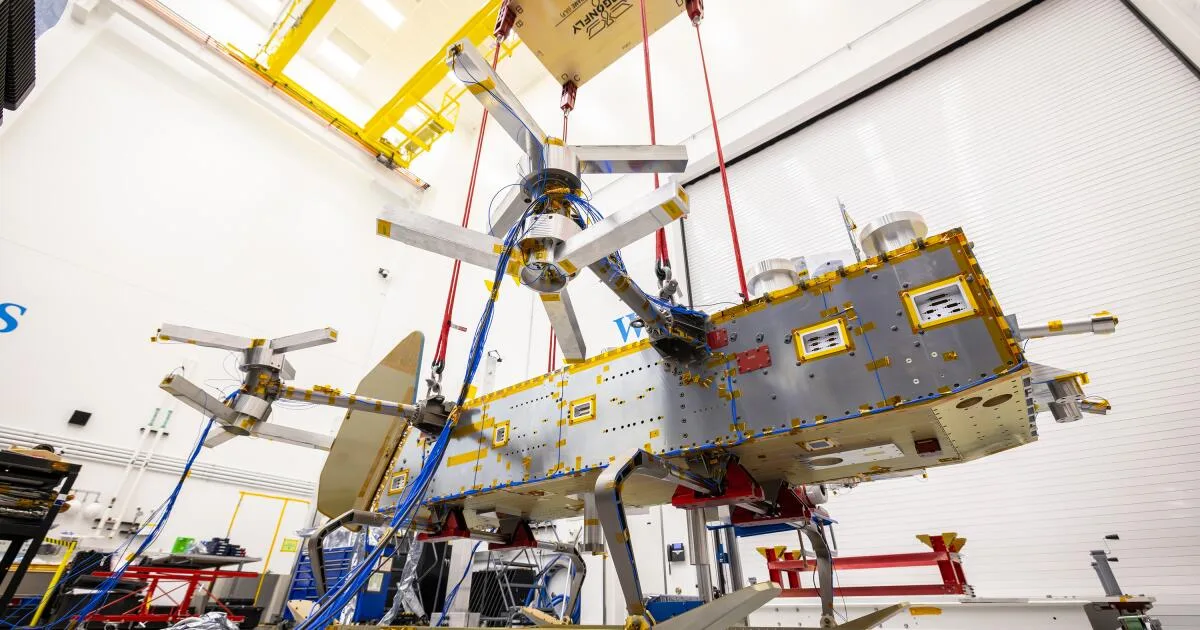
NASA's Dragonfly mission aims to revolutionize planetary exploration by flying a rotorcraft over Titan, Saturn’s largest moon, to search for signs of life in its unique and frigid environment. Currently being assembled at Johns Hopkins University’s Applied Physics Laboratory, this nuclear-powered drone is designed to hop across Titan's dense methane atmosphere and study its surface in unprecedented detail.
Dragonfly’s launch is scheduled for mid-2028, marking it as NASA’s last major planetary science mission for the near future. The spacecraft, roughly the size of a compact car, features eight rotors that will enable it to fly for several miles at a time. Following the installation of these rotors, teams will add scientific instruments and a compact nuclear power source shielded with special thermal foam to protect its systems from the extreme cold of space.

Titan presents a distinct environment among celestial bodies due to its thick methane atmosphere and hydrocarbon lakes—the only place besides Earth known to have stable liquids on its surface. The moon's environment is extremely cold, dropping to nearly -290 degrees Fahrenheit, making the potential for life in surface conditions unlikely. However, beneath its icy crust, a subsurface ocean exists, which some scientists believe could harbor conditions suitable for life. The Dragonfly mission seeks to explore these possibilities by collecting samples and analyzing Titan’s geology and atmosphere.
More than a thousand specialists from multiple institutions collaborate on the Dragonfly project. NASA’s Jet Propulsion Laboratory supports the mission by developing its flight paths and operating communications through the Deep Space Network, a system of giant antennas that will connect Earth with the distant craft. The mission’s lead scientist conceived the idea of a drone navigating Titan’s atmosphere over two decades ago, transforming an early theoretical concept into a tangible exploratory tool.