

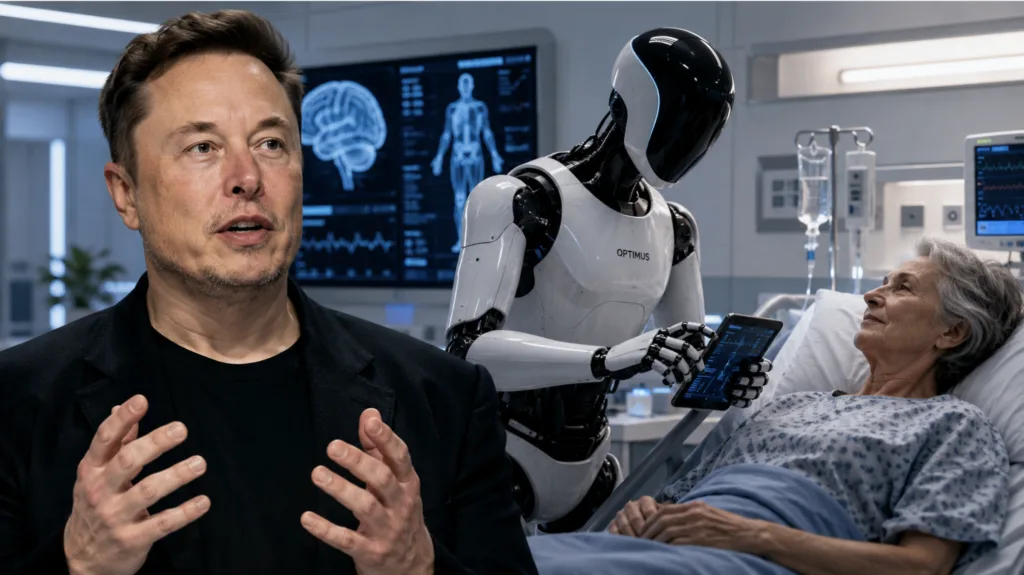
Elon Musk has outlined an ambitious vision where Tesla’s Optimus humanoid robot, powered by advanced artificial intelligence, will transform healthcare by making exceptional medical services universally available. Musk suggested that this innovation could provide care surpassing what even the wealthiest individuals receive today.
The CEO shared this outlook through a post quoting Peter Diamandis, highlighting Optimus’s dexterity and precision capabilities, which could be adapted for complex medical tasks. This marks a significant step in Tesla’s shift toward humanoid robotics, following the conversion of its Fremont factory from vehicle production to focus on Optimus manufacturing.

Tesla aims to scale Optimus output by developing up to 40 production lines, signaling a major investment in robotics. Musk emphasized the robot’s potential to perform high-precision operations, which are crucial in healthcare settings. This approach aligns with Tesla’s broader strategy to integrate AI technology into practical, real-world applications beyond automotive.
Supporting this vision, ARK Invest, led by Cathie Wood, released an analysis portraying humanoid robots and AI as drivers of new employment opportunities rather than threats. The firm compared the current concerns about automation to historical fears during the Internet’s rise, which ultimately did not hinder broad job growth. They also highlighted the remarkable technical complexity of creating a humanoid robot, estimating the required investment in computing power at approximately $50 billion to achieve human-level task proficiency.
ARK Invest’s research projects that Tesla’s Optimus could reach this technological milestone by around 2028, though they note competitive efforts from China in this race. This outlook points to Optimus as a pioneering development likely to reshape multiple industries, with healthcare being a prominent example.