

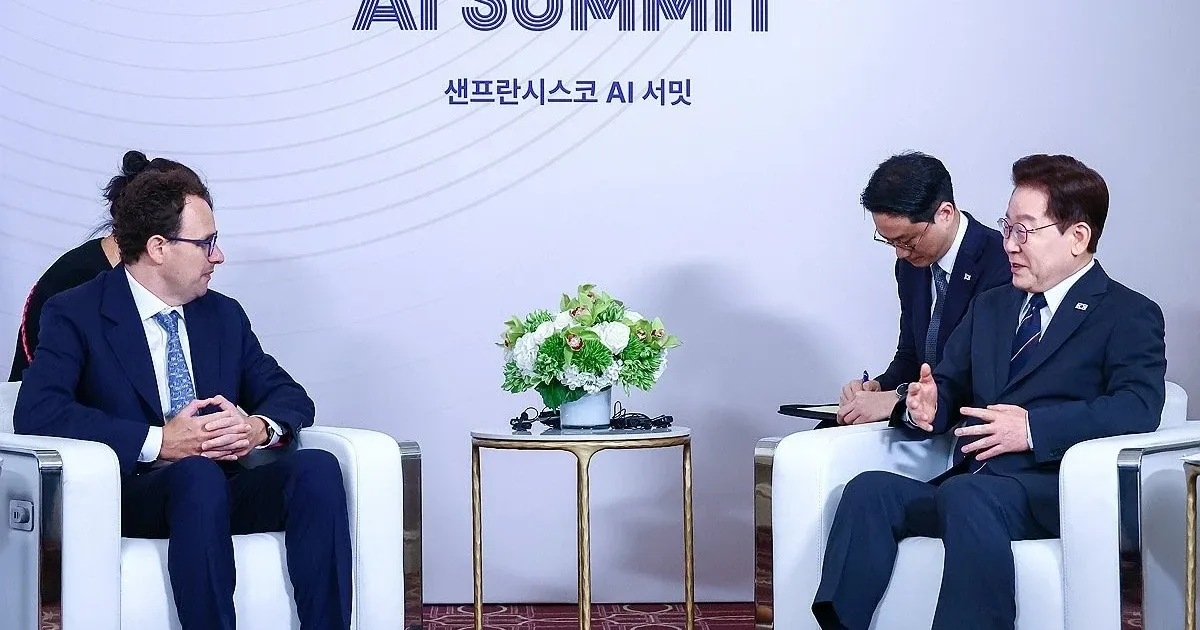
South Korea is positioning itself at the forefront of artificial intelligence innovation through a sweeping investment plan and strategic international partnerships. President Lee Jae Myung convened a high-profile AI summit in San Francisco, bringing together executives from Nvidia, OpenAI, and Broadcom, while announcing a $950 billion initiative involving key domestic firms like Samsung Electronics and SK Group.
The summit also introduced the San Francisco AI Declaration, a political framework signaling South Korea's ambition to move beyond being a mere consumer of AI technologies. Instead, Seoul aims to take a leading role in the design, deployment, and regulation of AI systems globally. This reflects a broader strategy to turn South Korea's manufacturing and semiconductor strengths into critical leverage within the AI supply chain.

South Korea's semiconductor industry already ranks among the world’s most influential, anchored by companies such as Samsung Electronics and SK Hynix. As demand surges for faster chips capable of powering advanced AI models, the country's control over chip capacity and cloud infrastructure becomes both an economic and strategic priority. This development underscores how advancements in hardware are inextricably linked with AI’s evolution.
President Lee’s visit to San Francisco was part of a broader diplomatic tour spanning multiple continents, including stops and summits in South America and Germany. Reuters reported that meetings in Brazil, Chile, and Argentina are part of an effort to blend industrial ambition with foreign policy goals, seeking to ensure that South Korean exporters and tech firms maintain a strong presence in the global AI race.
The scale and ambition of South Korea’s initiatives raise important questions about the balance of influence between domestic interests and foreign tech giants. While global partnerships can attract investment, talent, and computing resources, Seoul faces the challenge of establishing governance frameworks that protect national priorities on data control, market competition, and innovation autonomy.
For now, Lee’s message is clear: South Korea wants to transcend its historical role in technology markets as a buyer and become a proactive leader in shaping how AI is developed and regulated worldwide. The San Francisco AI Declaration and the accompanying investment plan mark South Korea’s bold entry into a contest dominated by the United States and China.