

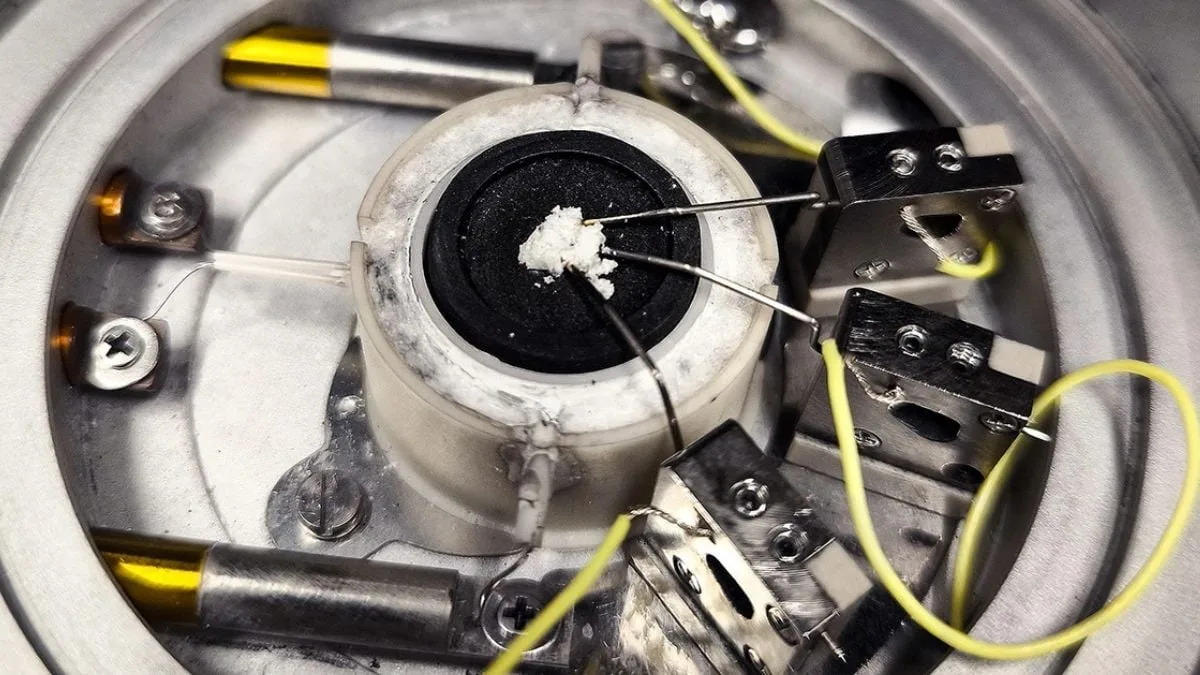
A team of chemists has, for the first time, visually tracked how carbon dioxide drawn from the air converts into solid carbon structures like graphite during molten salt electrolysis. This process, carried out at extreme temperatures, rearranges CO2 molecules into valuable carbon materials that could support battery production and carbon capture technologies.
Using operando Raman microscopy, the researchers traced the molecular changes in real time as carbon gradually formed on different electrode materials. Their observations confirmed a long-theorized two-step reaction mechanism involving carbon-adsorbed peroxide as a key intermediate. The team captured spectral signatures alongside the carbon buildup, providing unprecedented insight into how the reaction unfolds at the atomic level.

The study detailed distinct carbon morphologies depending on the electrode composition. Nickel cathodes yielded carbon nanotubes and platelet shapes, Inconel 600 alloys primarily produced platelet carbon, gold electrodes generated amorphous carbon clumps, while tungsten electrodes created mixtures of amorphous and other carbon forms. This variation suggests electrode material strongly influences the quality of carbon products formed during electrolysis.
This breakthrough offers a clearer understanding of the fundamental chemistry behind converting greenhouse gases into useful materials. Molten salt electrolysis, which operates at around 500 degrees Celsius, could become a promising method for synthesizing critical battery components while simultaneously reducing atmospheric CO2.
The ability to directly observe reaction intermediates and carbon growth dynamics opens avenues for optimizing and tailoring the process. By controlling electrode type and reaction parameters, manufacturers may design carbon materials with specific properties for energy storage applications. This work marks a significant advance in sustainable material synthesis where carbon capture and value creation intersect.