

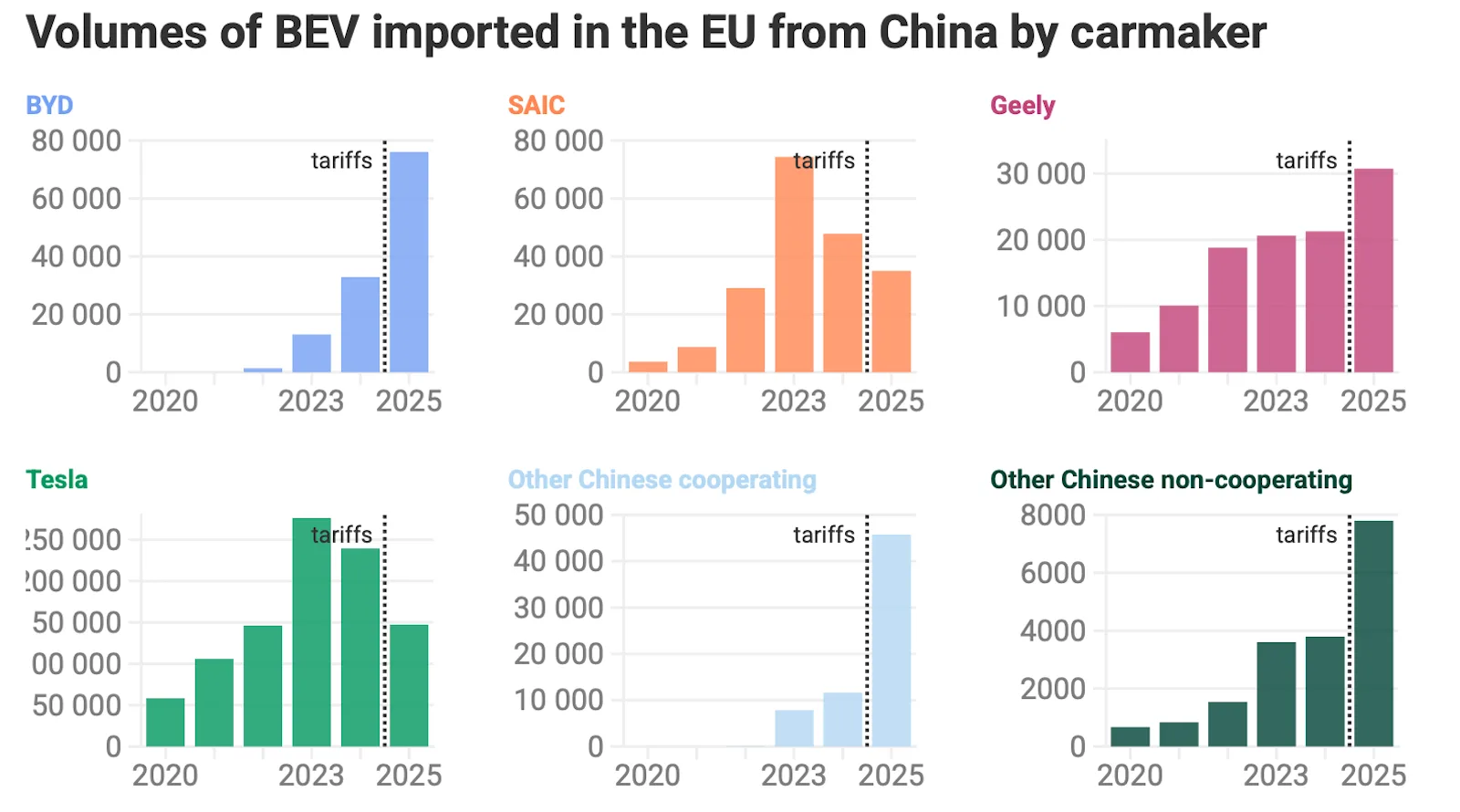
The European Union’s tariffs on electric vehicles imported from China have produced a mixed set of outcomes for various automakers, according to a recent report by Transport & Environment (T&E). While some Chinese manufacturers managed to increase their sales in Europe, others experienced significant declines, highlighting divergent impacts within the sector.
Chinese brands BYD and Geely showed notable resilience with rising sales following the tariff implementation. BYD benefited from a lower tariff rate of 17%, allowing its battery electric vehicle (BEV) sales to more than double year over year. In contrast, SAIC, which faced higher tariffs of 35%, saw its sales decrease sharply. Tesla, despite facing relatively low tariff penalties, struggled with weaker demand in Europe and began shifting production to its Berlin factory to reduce reliance on imports from China.

These tariff-driven shifts, however, do not reveal the full picture. While BYD and others grew their European presence, the report emphasizes that these companies may have absorbed tariff costs by reducing profit margins rather than solely gaining market share. Moreover, the overall share of China-made EVs in Europe shrank from 22% in 2024 to 17%, although absolute sales volumes stayed around 350,000 units annually, indicating that growth elsewhere or tariff effects influenced market dynamics.
Beyond sales figures, the report highlights a significant surge in Chinese EV exports, with Europe becoming a key destination for overcapacity absorption. Chinese automakers now direct about 30% of their exports to Europe, including 8% to the UK, despite the EU’s protective tariffs designed to shield local manufacturers and U.S. companies like Tesla. On the other hand, U.S. original equipment manufacturer (OEM) exports to Europe have declined slightly, while European OEM exports increased modestly.
The findings suggest that while EU tariffs have helped protect European and U.S. EV producers to some extent, they have not fully curbed the influx of Chinese-made electric vehicles. Growth patterns and shifting tariff rates across companies underscore complex trade dynamics shaping the European EV market today.