

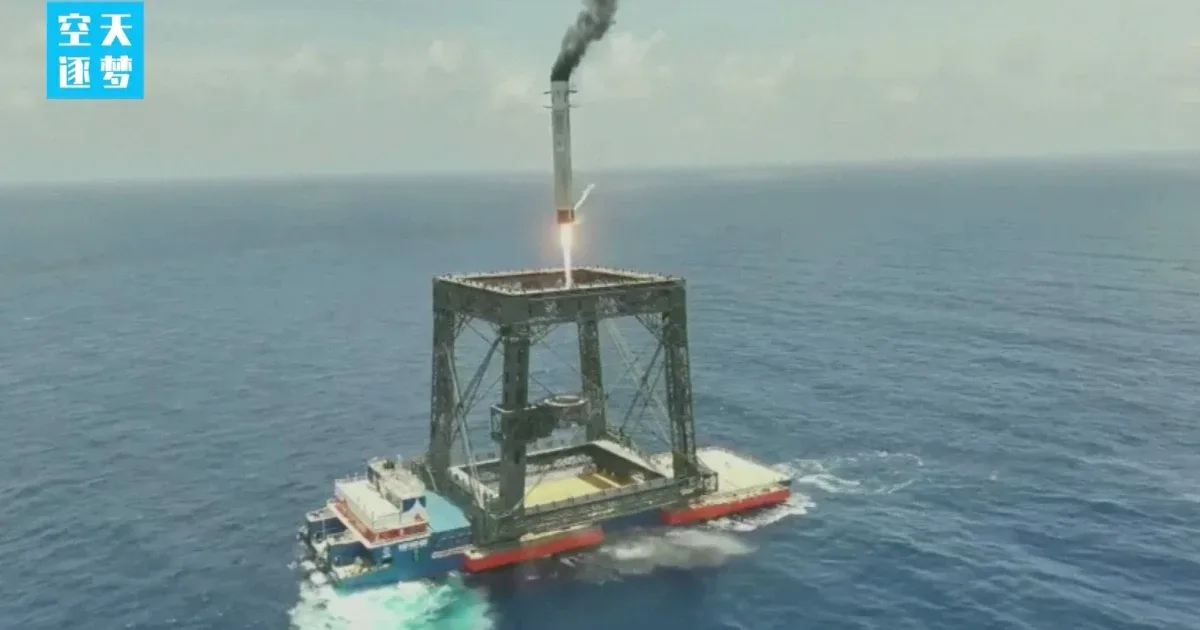
China marked a significant milestone in space technology by successfully recovering the first stage of an orbital rocket. The Long March 10B booster returned to Earth vertically and was captured by a net mounted on a sea platform approximately six minutes after separating from the rocket’s upper stage. The launch occurred from the Hainan commercial spaceport, establishing China's entry into the reusable booster domain.
The recovery technique directly challenges the industry model popularized by SpaceX’s Falcon 9, where reusing rocket stages lowers costs, speeds turnaround, and increases launch frequency. This advancement is critical for China's expanding satellite ambitions and crewed lunar missions. The Long March 10B’s reusable configuration is designed to carry up to 16,000 kilograms to low Earth orbit, supporting a wide range of space activities.

This breakthrough follows a rapid progression in China’s rocket development efforts amid mixed previous results. Earlier, the Long March 12 series saw partial successes and failures— the 12B variant debuted without recovery attempts, while the 12A failed its first-stage recovery during descent. Various Chinese aerospace entities, including the China Aerospace Science and Technology Corporation, are advancing reusable rocket systems to compete with established players in the global launch market.
China’s ability to safely bring back an orbital-class booster after launch reflects rapid technical progress and rising operational demands in its space sector. While the race to match SpaceX’s economic efficiency continues, this achievement provides the clearest evidence yet that China can develop and operate reusable rocket technology at an orbital scale.