

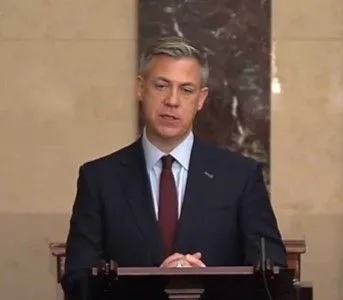
A Republican senator from Indiana has called on the US Commerce Department to enhance patent protections in response to concerns that Chinese firms are leveraging artificial intelligence to mine and appropriate American biotechnology patents. The senator warned that this practice undermines US innovation, threatens pharmaceutical research and development, and deepens America’s reliance on Chinese biotechnology manufacturing.
In a letter addressed to the Commerce Secretary, the senator highlighted a growing trend where Chinese companies use AI to analyze US patent applications rapidly, pinpoint commercially viable discoveries, and file derivative patents before original American inventors can commercialize their products. This “patent scraping,” as the senator described it, intensifies intellectual property threats and risks diminishing incentives for US companies to invest in costly research efforts, especially given China’s accelerated drug approval processes.

The senator also underscored the broader strategic implications of US dependence on China’s biotechnology sector. Since the 1980s, China has prioritized biotechnology as a strategic industry, heavily investing in research infrastructure and streamlining regulations to hasten product development. Many US pharmaceutical companies have shifted active pharmaceutical ingredient (API) and generic drug manufacturing to China due to lower costs, increasing America’s vulnerability in global supply chains.
Citing a recent survey by the Biotechnology Innovation Organisation, the senator noted that a significant majority of US biotechnology firms maintain contracts or product agreements with China-based manufacturers. This reliance, he argued, exposes American industries to a foreign adversary intent on exploiting and undercutting them.
Concern also extends to the strain AI-driven patent filings impose on the US Patent and Trademark Office (USPTO). The senator warned that large volumes of AI-generated applications, often with minimal human input, could overwhelm examiners, exacerbate backlog issues, and complicate the evaluation of prior art. These challenges threaten the integrity and efficiency of the patent system itself.
To address these risks, the senator urged continued reforms at the USPTO focused on safeguarding US inventions from AI-enabled duplication by foreign competitors. Strengthening patent review standards, enhancing detection of derivative filings, and accelerating efforts to counter automated patent mining were among his recommendations to protect American innovation and maintain leadership in biotechnology.