

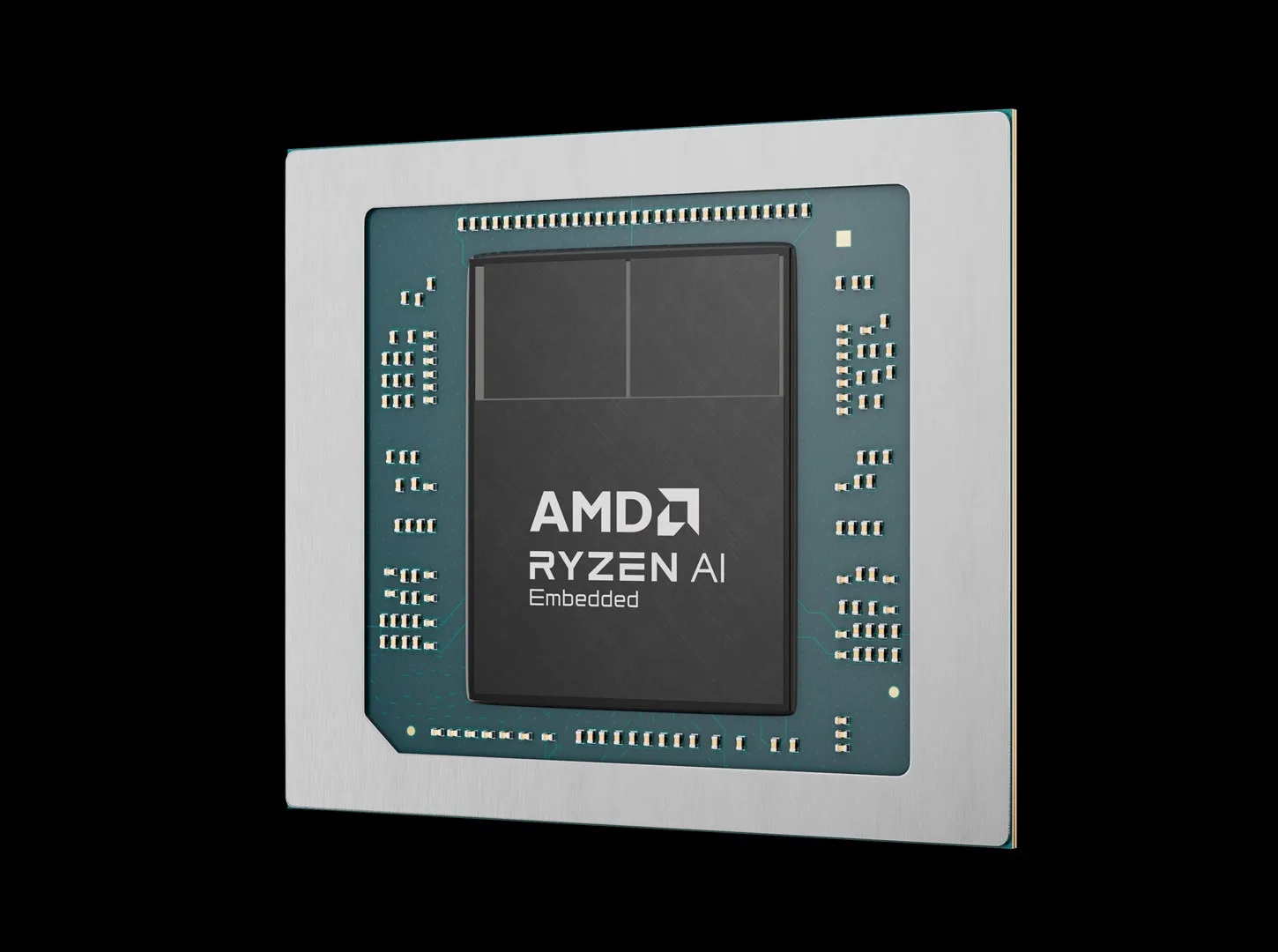
AMD expanded its AI portfolio with the launch of the Ryzen AI Embedded X100 processor family and the Kria AI System-on-Module (SoM), integrated into the Kria AI Robotics Developer Platform. These new products target physical AI applications across sectors such as robotics, industrial automation, healthcare, unmanned aerial vehicles (UAVs), media production, and interactive entertainment.
The Ryzen AI Embedded X100 series delivers significant performance gains over comparable platforms. AMD highlights up to 2.1 times higher multithreaded CPU performance and 1.7 times improved graphics output versus Intel’s Core Ultra Series 3 processors. Token generation throughput also sees a 3.5-fold increase, with 1.4 times faster times to first token on AI workloads like the llama-bench benchmark. Compared to NVIDIA’s Jetson Thor T5000 platform, the X100 family achieves up to three times greater peak FP32 performance and outpaces discrete GPUs such as NVIDIA’s RTX 4000 Ada in specific AI tasks like beamforming in advanced medical ultrasound.

Six variants compose the Ryzen AI Embedded X100 lineup, including the AMD Ryzen AI X199, X188, X168, and their industrial-grade versions: X199i, X188i, and X168i. All models are built on Zen 5 architecture, pair an AI neural processing unit capable of 50 trillion operations per second (TOPS) with a power envelope of 55 watts, and support extended temperature ranges up to 105°C for industrial environments.
Common technical features span high-bandwidth LPDDR5x-8533 memory support across up to eight channels with error-correcting code, advanced video encode/decode capabilities for up to 4K at 60Hz, and extensive display interface options including HDMI 2.1, DisplayPort 2.0, eDP 1.4, DVI, and USB4 with resolutions up to 8K at 60 frames per second. Peripheral connectivity incorporates USB4, USB 3.2, USB 2.0, and low-speed interfaces such as I2C, SMBus, SPI, and UART. The processors come in a compact 45 x 37.5 mm package and offer standard reliability warranties of 2.5 years extendable to 10 years.
The Kria AI SoM, designed to couple an X100 embedded CPU with a Kria FPGA, enables developers to accelerate physical AI workloads within a modular platform aimed at robotics and automation. This system complements AMD’s broader Advanced AI 2026 lineup, which also features the 6th Gen EPYC CPUs, AMD Instinct MI400 GPUs, and Helios AI rackscale solutions for data centers.
AMD backs these hardware advancements with an open software stack that includes Linux support, the AMD ROCm platform for integrated GPU workload acceleration, and virtualization capabilities via the Xen Hypervisor. Developers can also utilize industry-standard AI frameworks such as PyTorch, ONNX, and TensorFlow. Tools to facilitate migration from CUDA to ROCm are available, easing transitions for existing AI codebases.