

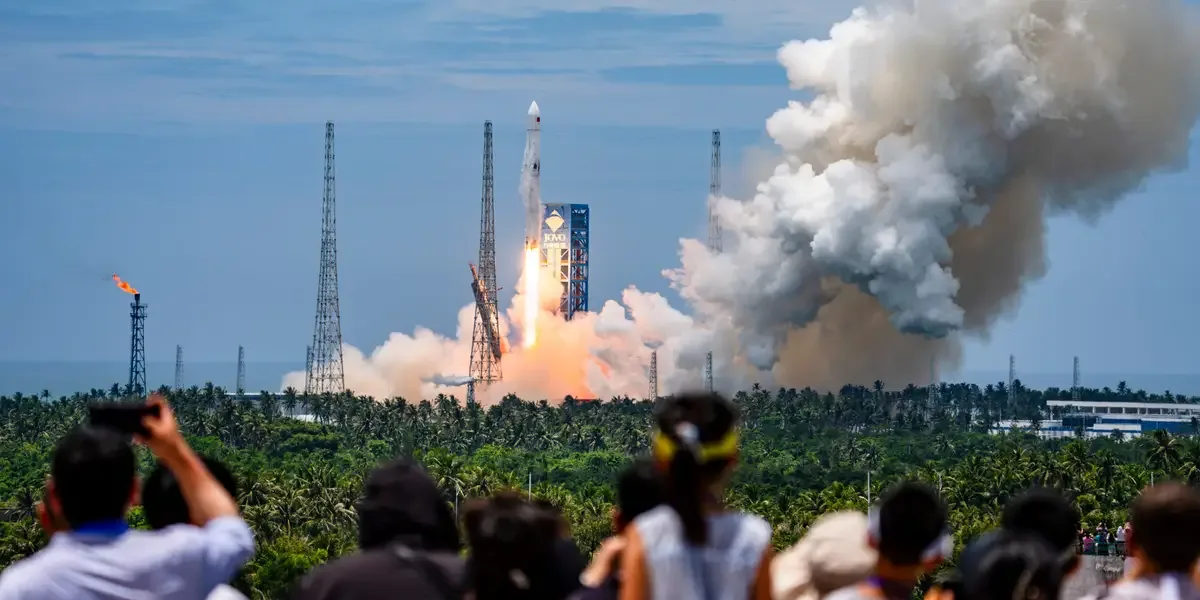
China has joined the elite group of space programs capable of recovering reusable rocket boosters after its Long March-10B completed a historic launch and safe return of its first-stage booster. The rocket’s booster stage landed on a barge approximately six minutes after liftoff and was caught by a large net, an unprecedented method in orbital rocket recovery.
This milestone positions China alongside Elon Musk’s SpaceX and Jeff Bezos’ Blue Origin, the only other organizations to have successfully landed orbital rocket boosters. Recovering the first-stage booster rather than discarding it in the ocean or burning it during reentry represents a critical advance that can lower launch costs significantly by enabling rocket reuse.

SpaceX pioneered booster landings with its Falcon 9 rockets, successfully recovering hundreds since the first in 2015. In 2024, SpaceX showcased further advancement by catching the massive Super Heavy booster of its Starship using robotic arms—named “Mechazilla”—at the launch site. Blue Origin achieved its first booster landing with the New Glenn rocket last year but faced a setback when a later New Glenn exploded on the launchpad in May.
China’s method stands out due to its use of a net-based capture system on a barge, reportedly the first of its kind for orbital-class rockets worldwide. This technique contrasts with the propulsive or landing-pad recovery methods favored by U.S. companies.
Despite this breakthrough, China's Long March-10B still trails SpaceX’s Falcon 9 in payload capacity, with the Long March capable of delivering up to 16 tons to orbit compared to Falcon 9’s 25 tons and SpaceX’s ambitious Starship program aiming for over 100 tons. China’s reusable rocket combines elements inspired by SpaceX’s Starship design, such as stainless steel structure and methane/liquid oxygen fuel, integrated into a Falcon 9-style architecture.
China’s space ambitions extend beyond launch vehicles, as a state-backed company called SpaceSai has launched about 200 satellites to build a satellite internet constellation. This effort aims to rival SpaceX’s Starlink network, which currently operates roughly 10,000 satellites in low Earth orbit.
China’s success with the Long March-10B demonstrates growing capabilities in reusable launch systems, an essential factor for reducing costs and increasing the frequency of space access. While still catching up to the operational maturity and scale of SpaceX, this achievement underscores China’s advancing presence in the competitive space launch sector.