

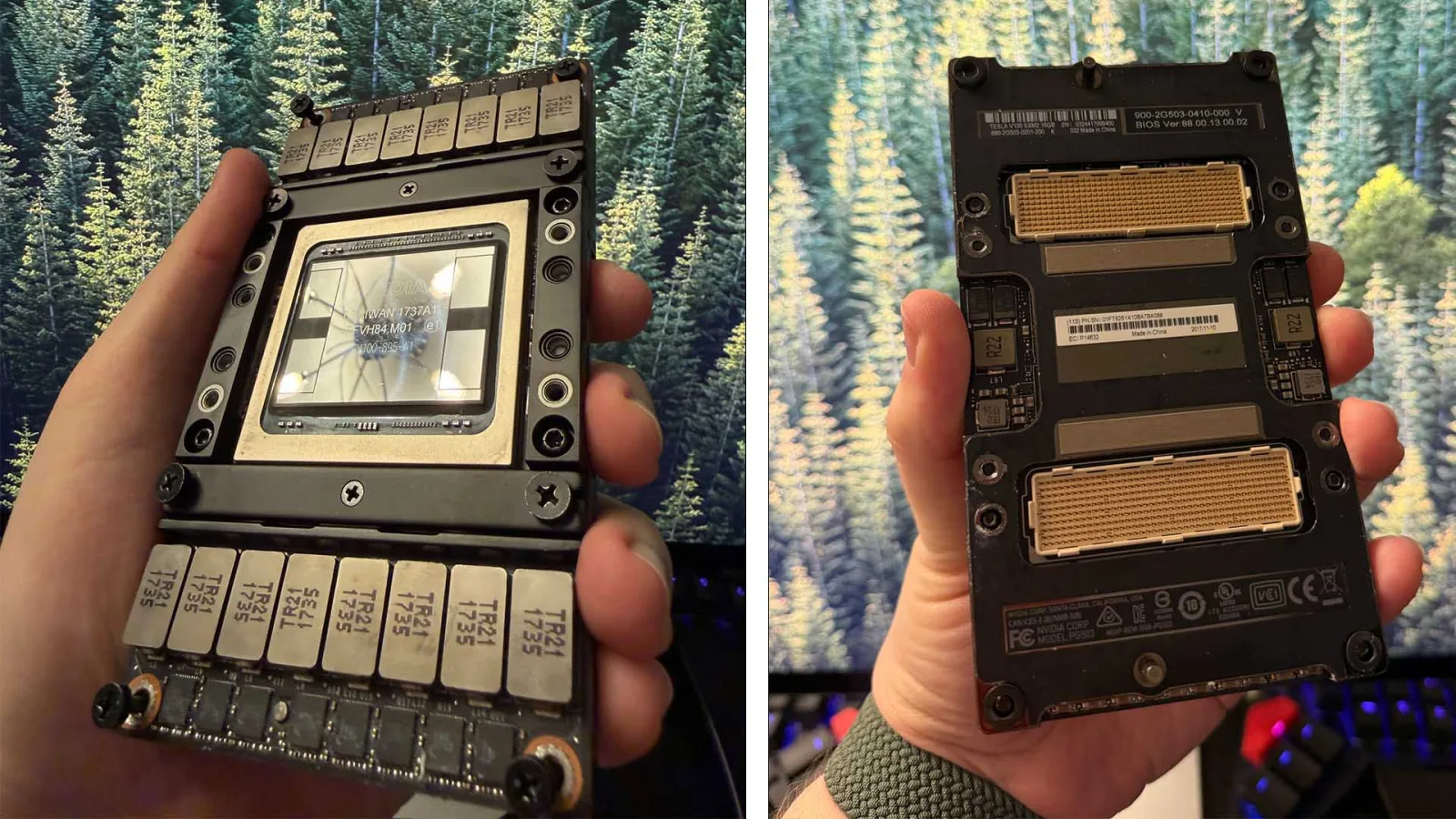
A gamer equipped with an NVIDIA RTX 4080 found that while the card excelled at handling graphically demanding AAA games, it fell short when running large language models (LLMs) that require extensive VRAM. To bridge this gap, the user successfully integrated an NVIDIA Tesla V100 GPU into the same desktop setup, unlocking 32GB of additional VRAM—enough to support sophisticated AI models like Qwen 3.6 at respectable processing speeds.
Since the Tesla V100 is designed for data center use, it lacks standard PC connectivity such as PCIe slots and display outputs. The modder overcame these hardware limitations by sourcing an SXM2-to-PCIe adapter, which cost approximately £200 ($266). Tesla V100 GPUs themselves with 16GB of HBM2 memory can be acquired for as low as $100 on secondary markets, making the upgrade relatively affordable compared to modern consumer GPUs.

The Tesla V100 offers 5,120 CUDA cores and a memory bandwidth of 900GB/s via its 4,096-bit memory bus, providing solid computational power despite being an older architecture. However, challenges arose with its original cooling system, a vapor chamber cooler generating noise levels around 82 decibels—uncomfortable for a home environment. The modder implemented a solution by powering the fan with a 9V battery and using a PWM jumper to reduce fan speed to 10% of maximum, significantly cutting down noise.
With the additional VRAM, the system could run complex AI models such as the Qwen 3.6 27B MTP quantized at Q5_K_M, which requires approximately 19GB of VRAM and supports context windows up to 128K tokens. The setup processed tokens at speeds between 133 and 160 per second for prompts, and could generate responses at around 32 tokens per second—performance considered decent for home computing on previous-generation AI GPUs.
This modification demonstrates an accessible approach to building a hybrid machine capable of gaming and AI workloads without relying on cloud services, delivering local AI model inference at a total cost under $300. While no current game fully utilizes 32GB of VRAM, this extra memory is critical for AI applications, marking a clear use case for repurposed data center GPUs in consumer hardware.