

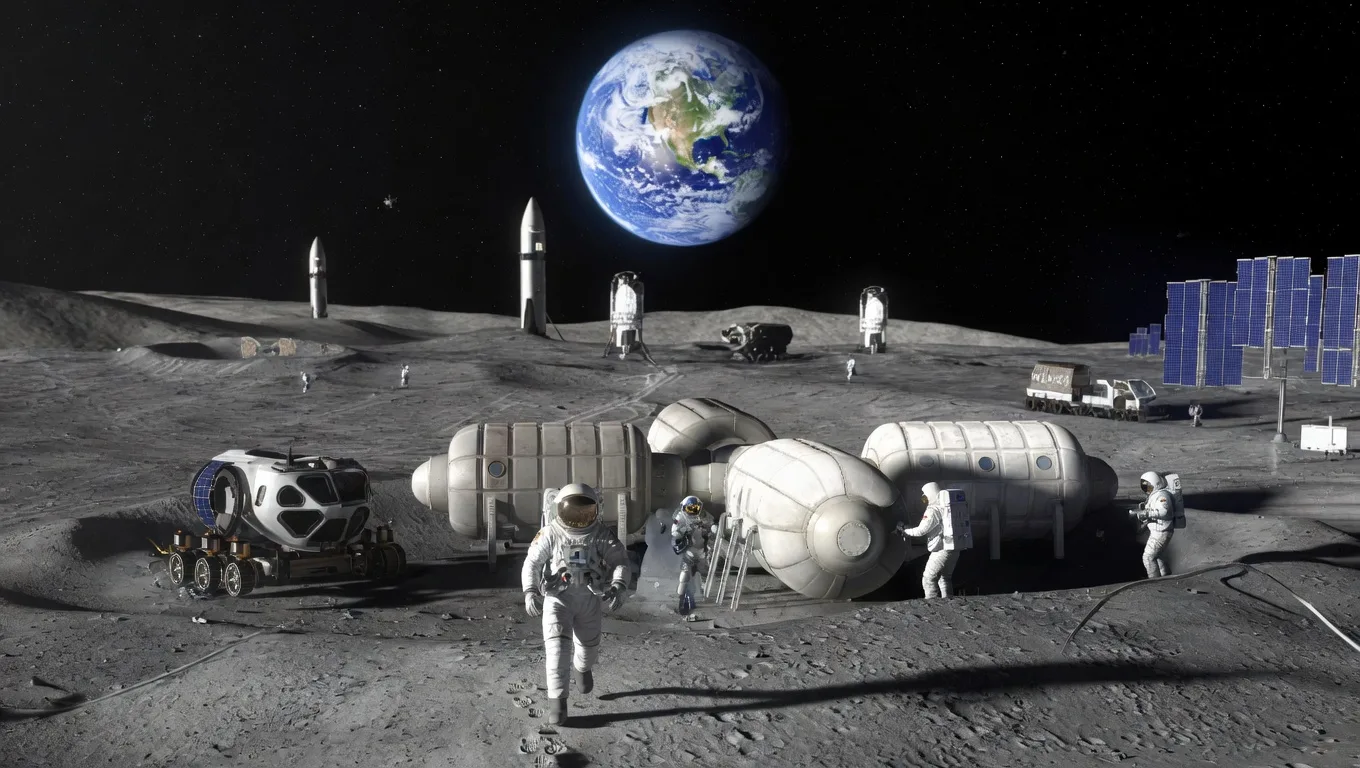
NASA has unveiled a comprehensive plan to build the first permanent human outpost on the Moon’s south pole, envisioning it as a critical stepping stone for future Mars exploration. The initiative involves a series of uncrewed and crewed missions set to launch throughout the next decade, delivering essential infrastructure, scientific instruments, and mobility systems to the lunar surface.
The initial deployment, Moon Base I, aims to transport scientific equipment via Blue Origin’s Blue Moon Mark 1 lander to the Shackleton Connecting Ridge, a key area targeted by Artemis astronauts. Following this, Moon Base II will deploy Astrobotic’s Griffin lander carrying cargo including Astrolab’s FLIP rover to begin testing surface mobility. Moon Base III plans to send the Lunar Vertex science mission on Intuitive Machines’ Nova-C Trinity lander, which will carry scientific payloads from ESA and South Korea to study unique lunar features called lunar swirls.

In parallel, NASA has invested in developing advanced rovers under the Lunar Terrain Vehicle project, awarding contracts to Astrolab and Lunar Outpost to deliver crewed rovers by 2028. Astrolab’s rover weighs around 2,000 pounds and reaches speeds of up to 6 mph, while Lunar Outpost’s Pegasus rover offers autonomous and remote control capability at speeds exceeding 9 mph. Cargo transport is supported by Blue Origin, which secured funding to provide landers capable of moving these rovers around the Moon’s surface.
SpaceX plays a pivotal role in the human landing phase of the program. Holding the contract for the NASA Human Landing System, SpaceX will use its Starship vehicle to ferry astronauts to the lunar surface as part of Artemis IV, currently planned for 2028. A significant technical hurdle involves demonstrating in-orbit refueling for Starship, requiring multiple tanker flights to ensure sufficient propellant for safe operations on and off the Moon.
Water ice deposits near the lunar south pole underpin the long-term sustainability of the base. This resource can be converted into drinking water, breathable oxygen, and rocket fuel, significantly reducing the need for resupply missions from Earth. The ability of Starship to land and refuel on or near the Moon will enhance this resource loop, forming a foundation for extended human presence and complex scientific activities.
Additional missions complement these efforts, such as MoonFall, tasked with deploying four survey drones to gather detailed data at future Artemis landing sites. Firefly Aerospace will build the transport spacecraft for this mission, targeting launch in 2028 to support upcoming crewed operations.