

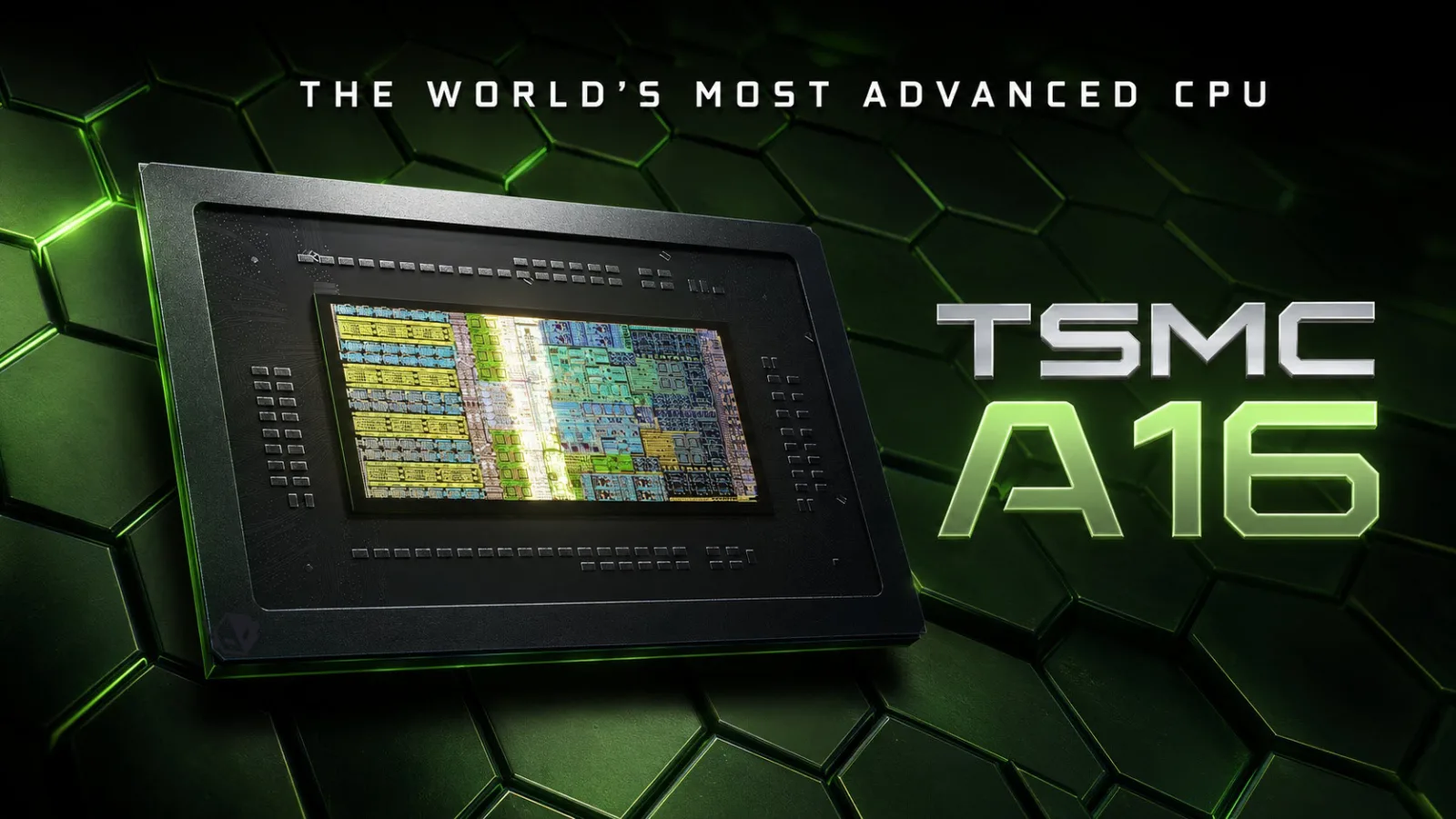
NVIDIA’s next-generation Rosa CPUs are set to leverage TSMC’s latest semiconductor fabrication technologies, with sources indicating the use of either the 2nm node or the innovative A16 process. Central to this development is TSMC’s Super Power Rail technology, which implements backside power delivery to enhance energy distribution and transistor efficiency in the chips.
Unlike traditional designs, the Super Power Rail separates power delivery and signal routing by dedicating the transistor’s front side to signal and clock distribution and the back side exclusively to power delivery. This unique architecture boosts logic density and yields a notable performance increase of 8 to 10 percent over the 2nm N2P process, while reducing power consumption by 15 to 20 percent at equivalent speeds. The chip density also improves by roughly 10 percent without enlarging the footprint.

This integration is expected to create increased demand for chemical mechanical polishing (CMP) processes and carrier wafers, benefiting Taiwanese semiconductor suppliers such as Suntech Power Semiconductor and Suntech Power Technology.
Rosa represents a continuation of NVIDIA’s efforts in AI-optimized CPUs, introducing a custom core architecture named Rigel. This design builds on the Arm v9.2 CPU core architecture and aims to deliver higher single-threaded performance compared to NVIDIA’s previous Vera chips. While Vera incorporated custom Olympus cores providing roughly double the throughput over the Grace CPUs, Rosa’s Rigel cores focus on maximizing single-core performance gains within the same silicon footprint.
The chart below outlines the progression of NVIDIA’s AI CPU families:
- Grace: Based on Arm Neoverse V2; already shipping since 2023; 72 cores and 144 threads.
- Vera: Custom Olympus Armv9.2 cores; expected in 2026; doubles throughput over Grace via spatial multithreading.
- Rosa: Custom Rigel Armv9.2 cores; projected release in 2028 alongside Feynman GPUs; targets superior single-threaded performance.
Together with TSMC’s advanced manufacturing, Rosa is designed to balance power efficiency and peak CPU speeds, reinforcing NVIDIA’s leadership in AI-centric computing hardware. The collaboration also positions the semiconductor supply chain for increased activity surrounding wafer processing technologies linked to these next-generation processes.