

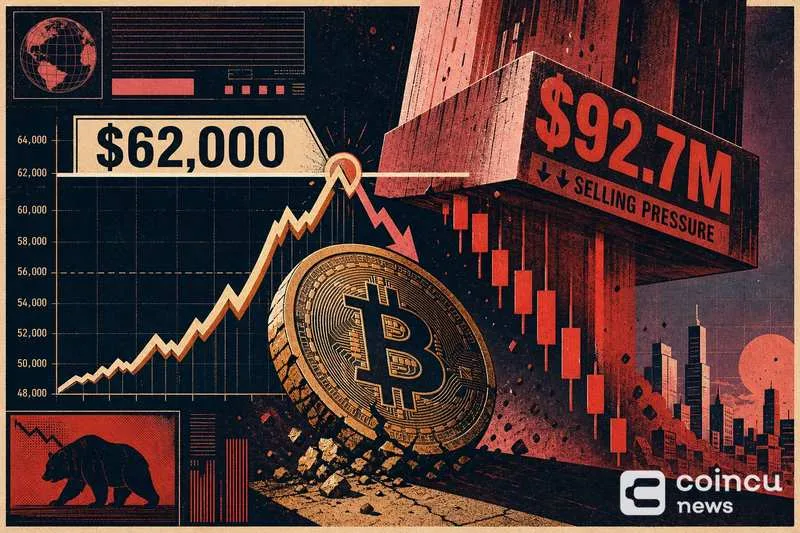
Bitcoin’s short-term recovery faltered following intense selling activity that absorbed nearly $92.7 million worth of buying power, forcing prices to retreat after an attempted bounce. This selling pressure, reported by market analysts, erased the brief uptick and underscored persistent weakness among buyers trying to push the cryptocurrency higher.
The key level to monitor is now $62,000, which acted as a strong resistance point where upward momentum stalled decisively. Analysts emphasize that Bitcoin needs to break through and hold above this threshold on significant volume to signal a meaningful recovery. Until then, the market risks remaining range-bound or slipping lower.

The heavy selling during the rebound suggests that major holders treated the short-lived price increase as an opportunity to offload rather than accumulate, reflecting a struggle between supply and demand near this level. This pattern resembles previous episodes where rallies near $60,000 collapsed under similar selling pressure, particularly from short-term traders exiting positions.
Market sentiment indicators reinforce this fragile environment. Tools like the Fear and Greed Index often show elevated fear levels during failed recoveries when buyers fail to maintain dominance, hinting at a cautious atmosphere among investors.
The near-term outlook hinges on whether Bitcoin can establish support below $62,000 and generate enough demand to break the resistance convincingly. A sustained move above this price with strong volume would indicate absorption of selling pressure and the potential for renewed gains. Conversely, repeated failures at $62,000 could deepen the pullback, undermining confidence in a sustainable recovery.