

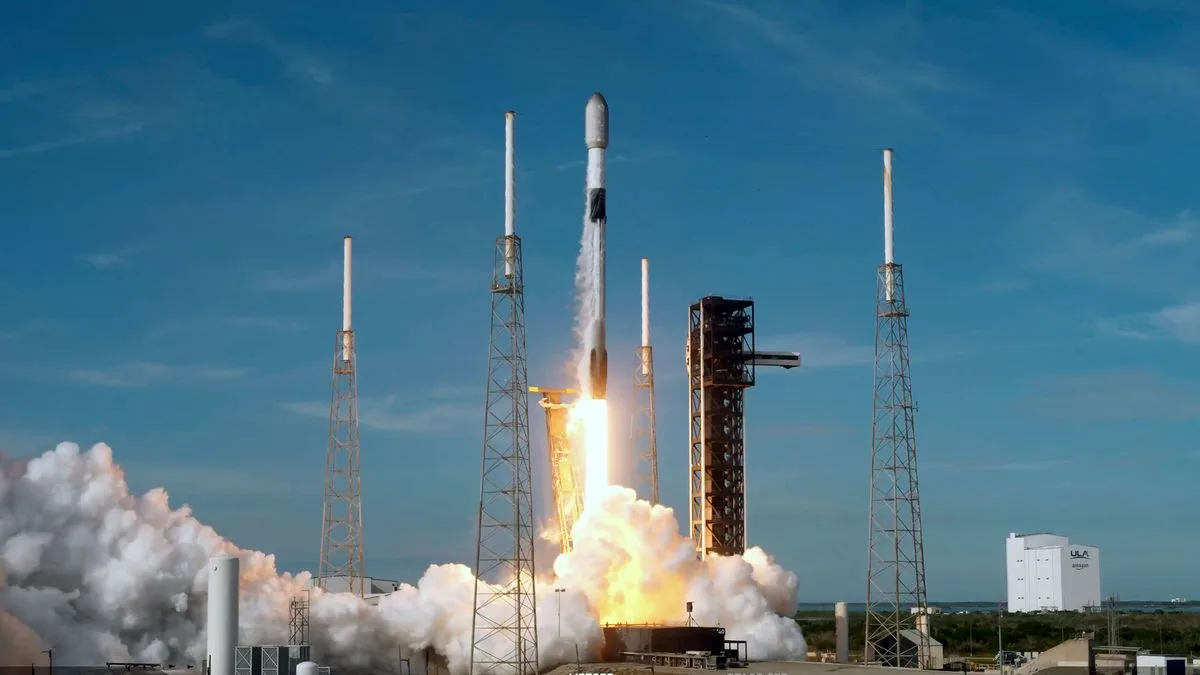
SpaceX placed 29 new Starlink satellites into low Earth orbit after a successful Falcon 9 launch from Cape Canaveral Space Force Station. The rocket lifted off early in the morning and delivered the broadband network spacecraft approximately an hour later, marking another step in expanding global internet coverage.
This launch came only hours after a significant setback on nearby Launch Complex 36, where Blue Origin’s New Glenn rocket exploded during a static fire test, producing a massive fireball visible over 100 miles away. The contrasting events highlighted ongoing challenges and advancements in the evolving commercial space sector.

The Falcon 9 first stage booster used for this mission completed its 16th flight and returned safely by landing on the autonomous droneship “A Shortfall of Gravitas” situated in the Atlantic Ocean. After retrieval, the booster will undergo servicing for future flights, continuing SpaceX’s push towards rapid rocket reuse.
With this deployment, the total operational Starlink constellation now exceeds 10,400 satellites worldwide. The Starlink network aims to deliver internet access to underserved regions, supporting connectivity in remote areas, in-flight WiFi, and some direct-to-cellular services.
Friday’s launch marked the Falcon 9 rocket’s 61st flight of the year and its 644th overall mission since its debut in 2010, underlining its role as a backbone for satellite deployment and commercial space activities.