

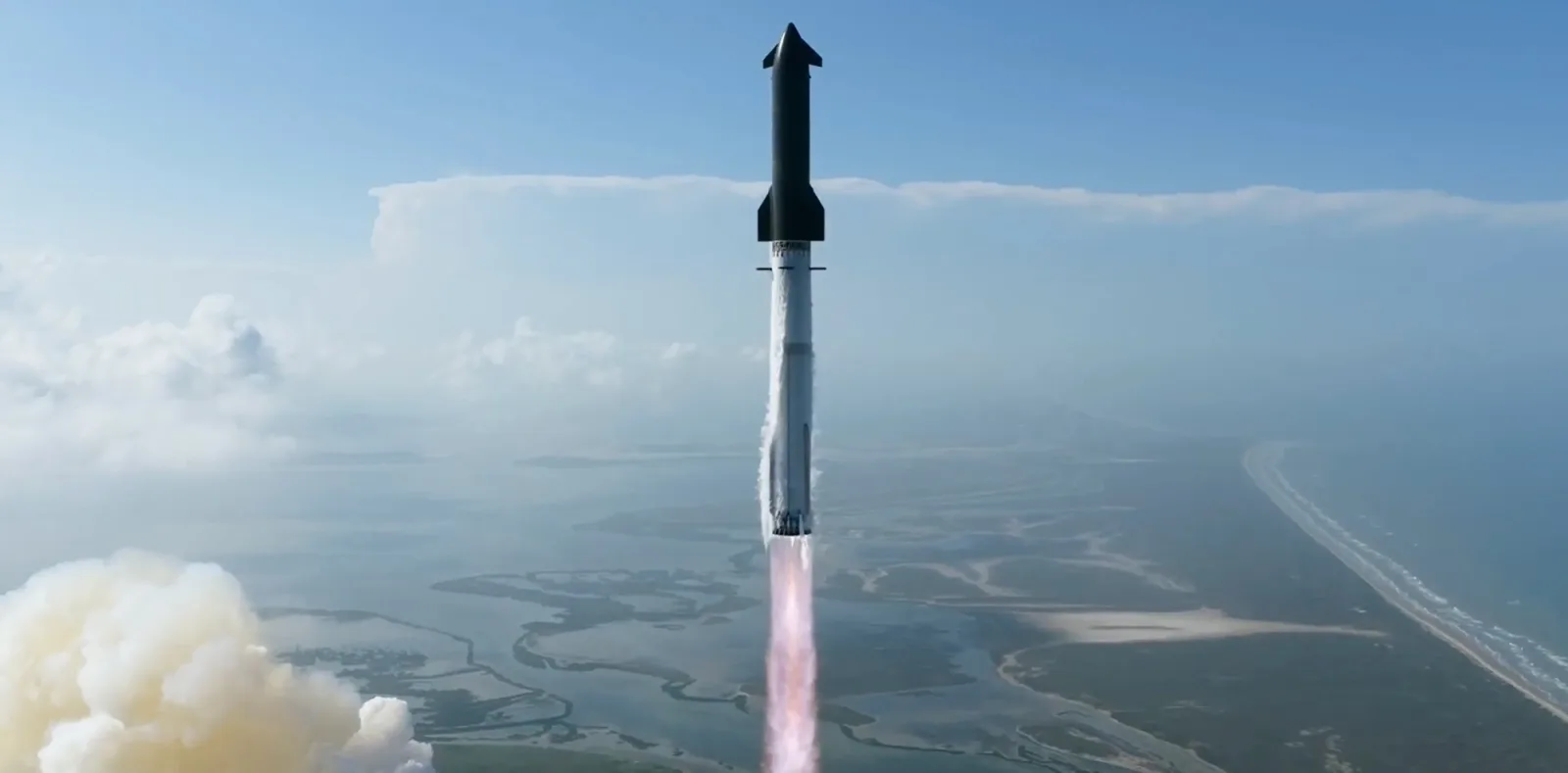
SpaceX launched the first flight of its upgraded Starship V3 vehicle from its Texas launch site, marking a key step in the spacecraft’s development. The suborbital mission achieved most of its test objectives, including the deployment of experimental payloads and demonstrating Starship’s engine-out resilience despite several engine shutdowns during flight.
The ascent began with the Super Heavy booster igniting 33 Raptor 3 engines, but one engine shut down less than two minutes after liftoff. Shortly after stage separation, the Starship upper stage fired six engines, with one vacuum-optimized engine shutting down early. SpaceX confirmed the vehicle’s engine-out capability by extending burn times on the remaining engines to maintain the planned suborbital trajectory.

Booster recovery faced difficulties. The Super Heavy booster attempted a boostback burn to steer toward a Gulf of Mexico splashdown but ignited only a few engines and lost thrust within 20 seconds, resulting in a high-speed hard splashdown. Telemetry indicated the booster was traveling around 1,500 kilometers per hour at low altitude when it hit the water.
In orbit, Starship deployed 20 mass simulators representing Starlink satellites and two experimental payloads nicknamed “Dodger Dogs,” which featured stretched propellant tanks designed for future V3 Starlink satellites. These miniature spacecraft carried cameras that provided in-flight footage of Starship and its heat shield.
Due to the earlier engine malfunction, SpaceX canceled a planned engine relight test. Nevertheless, Starship completed reentry and splashed down softly in the Indian Ocean as planned about 66 minutes after launch. The vehicle then tipped over and exploded as expected in a controlled conclusion to the test.