

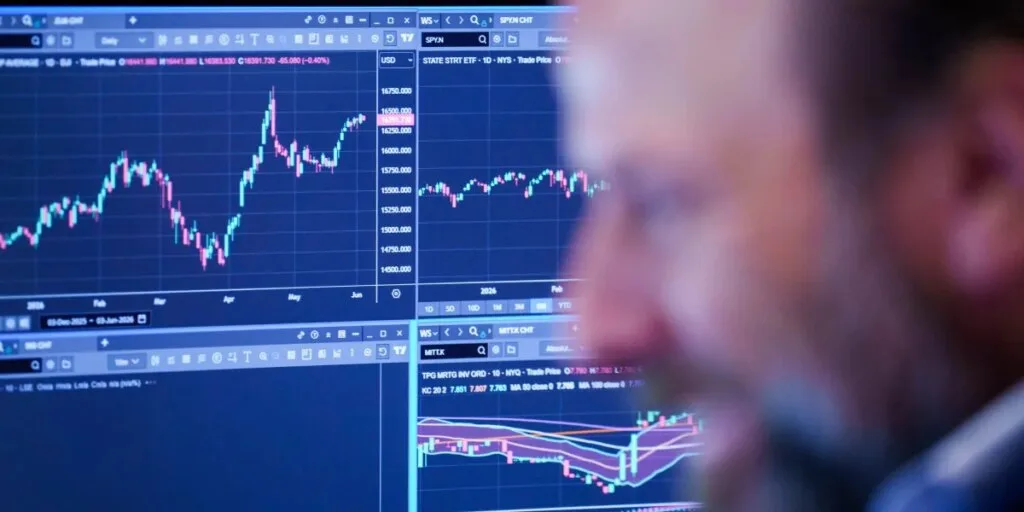
Wall Street experienced a dramatic market shift as tech stocks plunged sharply by midday, shedding almost $1 trillion in value, only to recover part of those losses by the close. The Nasdaq Composite initially dropped over 4% before halving its decline by the end of the day, reflecting intense volatility largely driven by investor uncertainty around artificial intelligence stocks.
Traders targeted the most speculative and volatile names, unloading high-beta tech companies including Strategy (a leveraged bitcoin fund), AppLovin, and Lumentum. The steepest sell-off hit semiconductor companies, notably Marvell, which tumbled 10% following a recent 10% gain linked to its S&P 500 inclusion. These stocks belong to a group labeled the “Parabolic 7,” which had surged nearly 100% in recent weeks, prompting some market participants to question the sustainability of the rally.

Rather than pulling completely out of equities, investors rotated into safer, more stable sectors. Consumer staples such as Smucker saw double-digit gains, while home improvement and paint companies like Home Depot and Sherwin-Williams led the market higher. Defensive categories including real estate, utilities, and staples recovered ground, providing ballast against the tech sell-off.
Market strategists suggested this rotation reflects growing wariness about the overheated tech segment. The recent rare capital raise by Alphabet signaled caution, while anticipation around SpaceX’s upcoming, potentially record-setting IPO spurred reallocation of funds. Confidential filings from AI competitors OpenAI and Anthropic add to investor uncertainty, prompting a broader reevaluation of AI-related investments.
Additional factors contributed to the market’s caution. Inflation reports scheduled for later in the week, combined with a robust May jobs report, are pushing expectations for Federal Reserve interest rate cuts further into the future. Investors tend to reduce exposure to highly volatile stocks ahead of key inflation data, which likely accelerated selling pressure in tech equities.
Industry experts noted the sell-off appeared driven more by a lack of buyers than by an overwhelming rush to exit. This absence of demand compressed stock prices faster than trading volumes would suggest, indicating a hesitation rather than a panic.
In contrast, oil prices declined despite geopolitical tensions following Iran’s downing of a U.S. Army helicopter near the Strait of Hormuz. Comments from the U.S. Energy Secretary that shipping traffic was improving weighed on crude futures, pushing prices down approximately 3% to around $88 per barrel.
The market now awaits the high-profile SpaceX IPO, which has already attracted substantial investor interest with multiple $10 billion bids. This event may clarify whether the market’s AI enthusiasm can sustain itself or if a broader rotation away from tech innovation stocks will continue.