

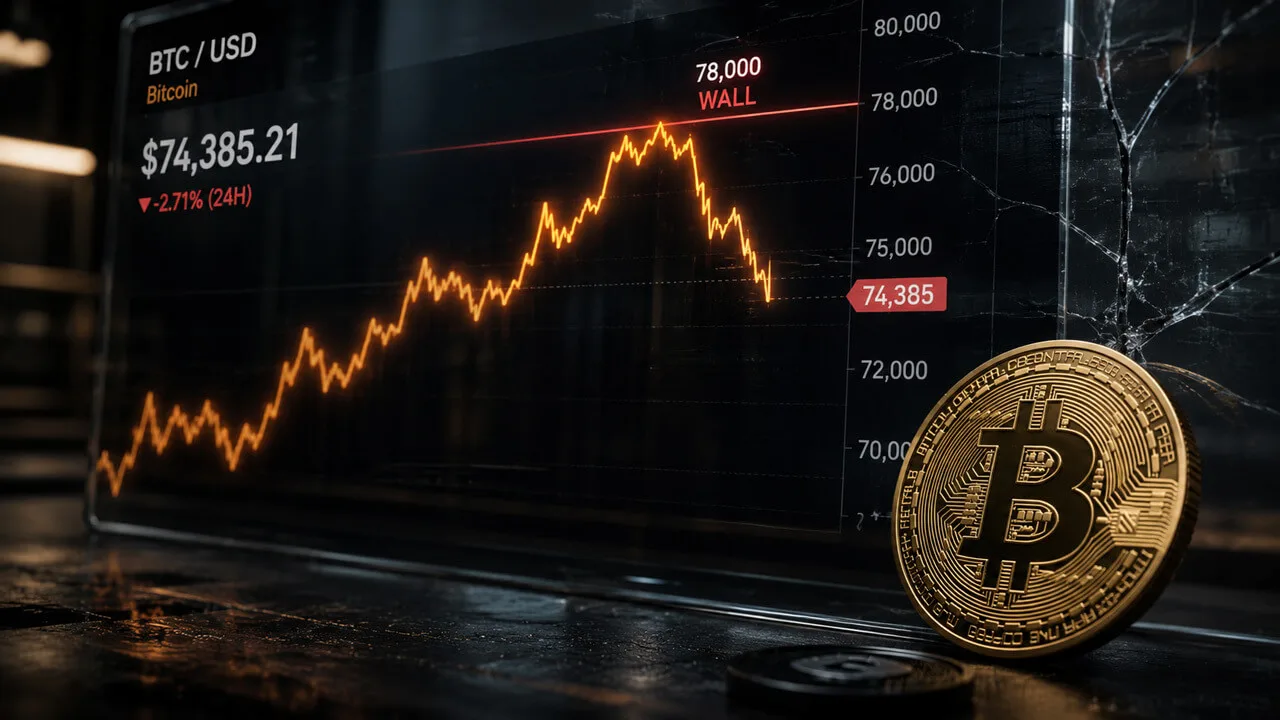
Bitcoin’s price slipped under $74,200 during intraday trading, marking a renewed loss of momentum following a failed recovery from earlier spring lows. This drop occurred after the cryptocurrency briefly fell below $75,000 on May 23 due to spot ETF outflows and forced liquidations. As the Asian market sold off, Bitcoin dipped to as low as $72,600 before stabilizing near $73,600 at press time.
Data from Glassnode highlights a critical resistance band between $75,000 and $78,000, where Bitcoin’s price faces a bottleneck. Demand from spot markets, ETF inflows, and options positioning have all retreated, weakening any push for a sustained rebound. This band aligns closely with key on-chain indicators such as the Short-Term Holder Cost Basis and the True Market Mean, both near $78,000. Trading below these metrics leaves recent buyers—the most price-sensitive group—at or below breakeven, turning them from a support base into potential sellers.

Options markets add to this pressure, with dealers heavily positioned around $75,000 strikes for the May expiry. Glassnode reports more than $8 billion in negative gamma concentrated near this level, meaning market makers must sell as prices drop and buy as prices climb. This dynamic compresses the price range and makes Bitcoin more sensitive to modest order flows around $75,000. However, the stalling at this resistance was primarily due to demand failure rather than mechanical hedging.
On-chain indicators show a retreat in spot buying activity, with the Spot Volume Delta shifting back toward sellers in recent trading sessions, erasing early May gains. ETF flows, which fueled the previous rally, have reversed dramatically; spot Bitcoin ETFs in the US shed approximately $2.26 billion in two weeks. Notable daily outflows included more than $600 million and several hundred million-dollar withdrawals across multiple days.
Market participants face broader headwinds, including constrained liquidity, elevated interest rates, volatile oil prices, a strengthening US dollar, and ongoing geopolitical uncertainties related to Iran. These factors contribute to Bitcoin's correlation with global risk appetite and limit its ability to regain footing amid the crowded resistance zone.