

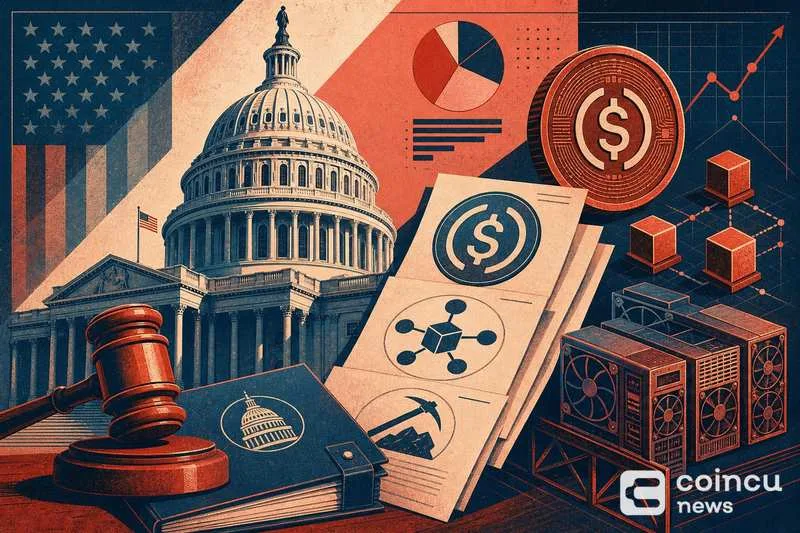
The U.S. House Ways and Means Committee has taken significant steps toward establishing a dedicated tax framework targeting key cryptocurrency activities, including stablecoin transactions, staking rewards, and mining income. This development positions crypto taxation as a distinct legislative priority, signaling Congress’s intent to clarify complex tax obligations within the digital asset ecosystem.
The committee plans a full hearing focused exclusively on digital asset taxation, underscoring the standalone importance of these issues rather than folding them into broader financial regulations. A bipartisan draft proposal, spearheaded by Representatives Miller and Horsford, forms the foundation for the legislation, although the bill is still subject to further committee review, potential amendments, and eventual voting before it could advance to the Senate.

The bill concentrates on three main areas where current IRS guidance leaves significant uncertainty. First, stablecoins—cryptocurrencies pegged to fiat currencies—are addressed with proposals to exempt small transactions, potentially under a $200 threshold, from capital gains reporting. This exemption aims to relieve everyday users from burdensome tax compliance on routine stablecoin payments.
Second, the legislation tackles the taxing of staking rewards, which are tokens earned by validators supporting proof-of-stake networks. A critical question is whether these rewards are taxable upon receipt or only when sold, a distinction that affects how much taxable income users report. Taxing rewards immediately can create challenges when token values fluctuate before disposal, a controversial point in the crypto community.
Third, mining activities—where proof-of-work networks generate new tokens through computational effort—face tax clarity proposals regarding income timing, accounting for costs such as hardware and electricity, and how mining income should be classified, including considerations if it qualifies as self-employment income. Clarifying these rules could impact operational viability, especially given the tight margins smaller mining businesses already endure amid cryptocurrency price swings.
For individual crypto users and industry participants, the legislation also highlights anticipated changes in tax-reporting responsibilities. Exchanges and wallet providers might see altered or expanded Form 1099 reporting requirements, affecting how user transactions are communicated to the IRS. Stakers and miners will pay close attention to the final guidance on income recognition and allowable deductions, which could reshape the economics of their activity in the United States.