

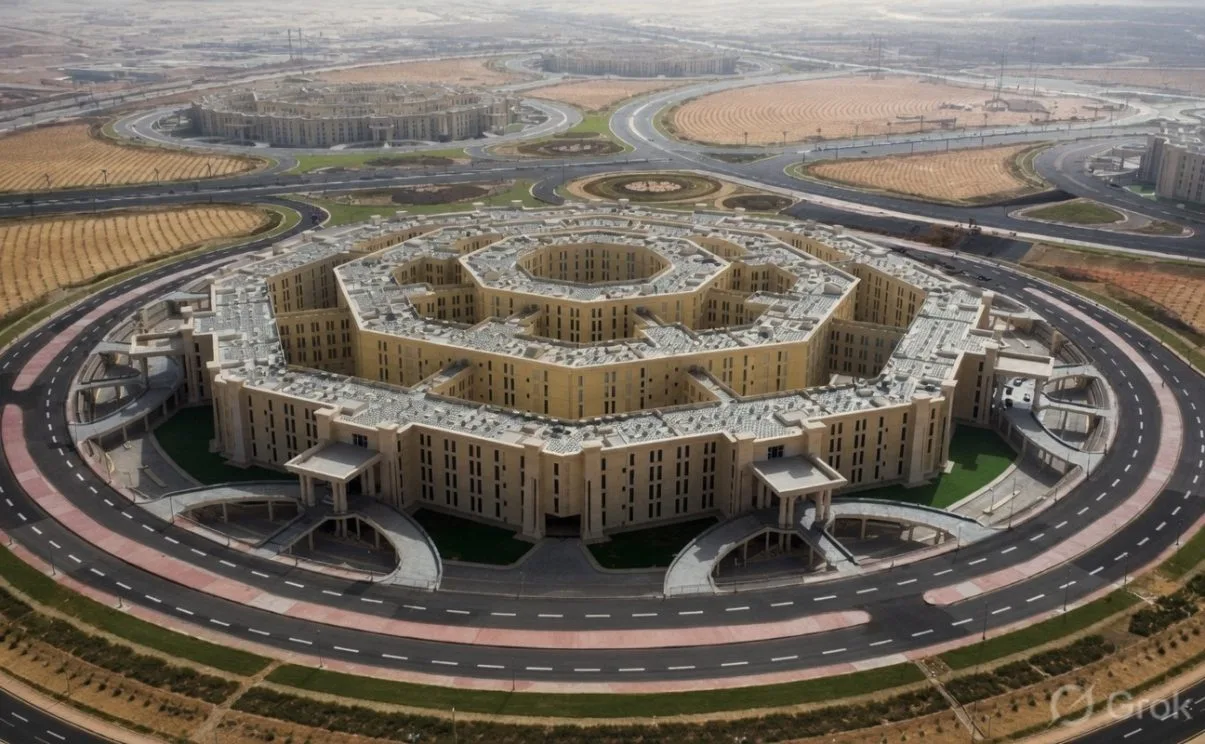
Egypt officially inaugurated The Octagon, the State Strategic Command Headquarters, marking a significant expansion of its military infrastructure. Spanning 22,000 acres within the New Administrative Capital nearly 45 kilometers east of Cairo, this sprawling complex exceeds the U.S. Pentagon in both land coverage and built-up area, with over 50 million square feet of space. The facility is designed to serve as the central command nexus for the Egyptian Armed Forces, enhancing coordination across all branches.
The Octagon’s architecture features eight interconnected octagonal buildings arranged around central structures, underscoring the unity of Egypt’s military commands. These buildings contain the primary operational centers, logistics units, and national emergency management teams. The complex also includes 13 designated functional zones and extensive underground facilities, built to endure crises and support uninterrupted command operations. State-of-the-art digital systems, artificial intelligence capabilities, and secure communication networks provide real-time data integration and command across military divisions.

Egypt’s strategic intent behind The Octagon ties into its broader plan to relocate key government and military functions from traditional centers in Cairo to the New Administrative Capital. By consolidating command under one fortified, technologically advanced roof, authorities expect to accelerate decision-making and crisis response while bolstering national defense resilience.
The design and scale mirror similar global defense headquarters such as the Pentagon in the United States. The Pentagon, headquarters of the U.S. Department of Defense, is symbolic for housing commanders across all military branches and managing administrative, intelligence, and logistical functions. The Octagon aims to fulfill a comparable role but with enhanced modern features tailored to Egypt’s specific military needs.