

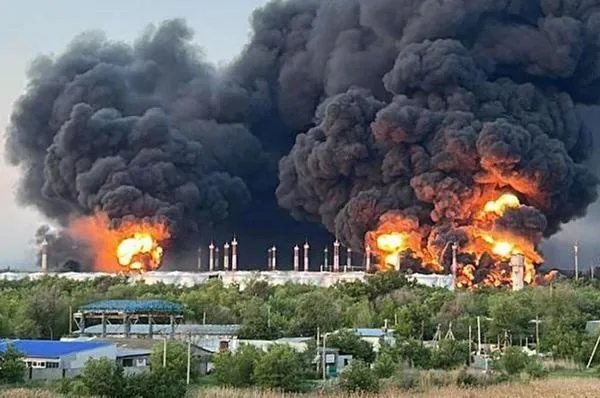
Ukraine has demonstrated a significant advancement in drone warfare by deploying around 1,500 long-range drones targeting sensitive Russian sites. This move reflects a transition from drones as battlefield tools to strategic strike assets, fundamentally changing how military escalation unfolds in the ongoing conflict.
Unlike conventional escalation, which typically progresses through clear, defined stages, drone warfare introduces a fluid process of continuous adjustment. The capacity to incrementally extend drone range, increase attack frequency, enhance payloads, and diversify target selection means escalation now resembles a gradual climb on a ramp rather than distinct steps on a ladder. This development complicates the identification of escalation thresholds, increasing the chances of unintended miscalculations between the involved parties.

Initially, Western discussions about supplying Ukraine with long-range strike capabilities focused on transferring complete, recognizable missile systems such as ATACMS, Storm Shadow, and Taurus—systems with clear political and strategic symbolism. These weapons posed a risk of provoking Moscow by providing overt NATO-supported deep-strike capabilities inside Russian territory, triggering fears of crossing critical red lines and direct NATO involvement.
However, the approach evolved toward a more distributed and modular model. Rather than delivering entire strategic missile systems, Ukraine and its backers leaned on assembling long-range drones from commercial and dual-use components, enhanced by satellite integration and adapted software. This decentralized production spans multiple smaller locations, reducing vulnerability to Russian interdiction and making escalation less politically visible. Such dispersion fosters resilience against suppression efforts and enables gradual growth in strike capabilities without the overt markers of escalation that come with delivering complete NATO missile platforms.
This distributed enablement strategy offers these key advantages:
- Decentralized assembly lowers risk of disruption from targeted strikes.
- Modular components lower the political profile linked to escalation.
- Preserves a formal separation between Ukraine’s strike capabilities and direct NATO involvement.
The shift raises complex challenges for managing escalation risks. Incremental drone operations blur traditional boundaries, demanding new frameworks for interpreting conflict thresholds amid evolving technological and strategic capabilities.