

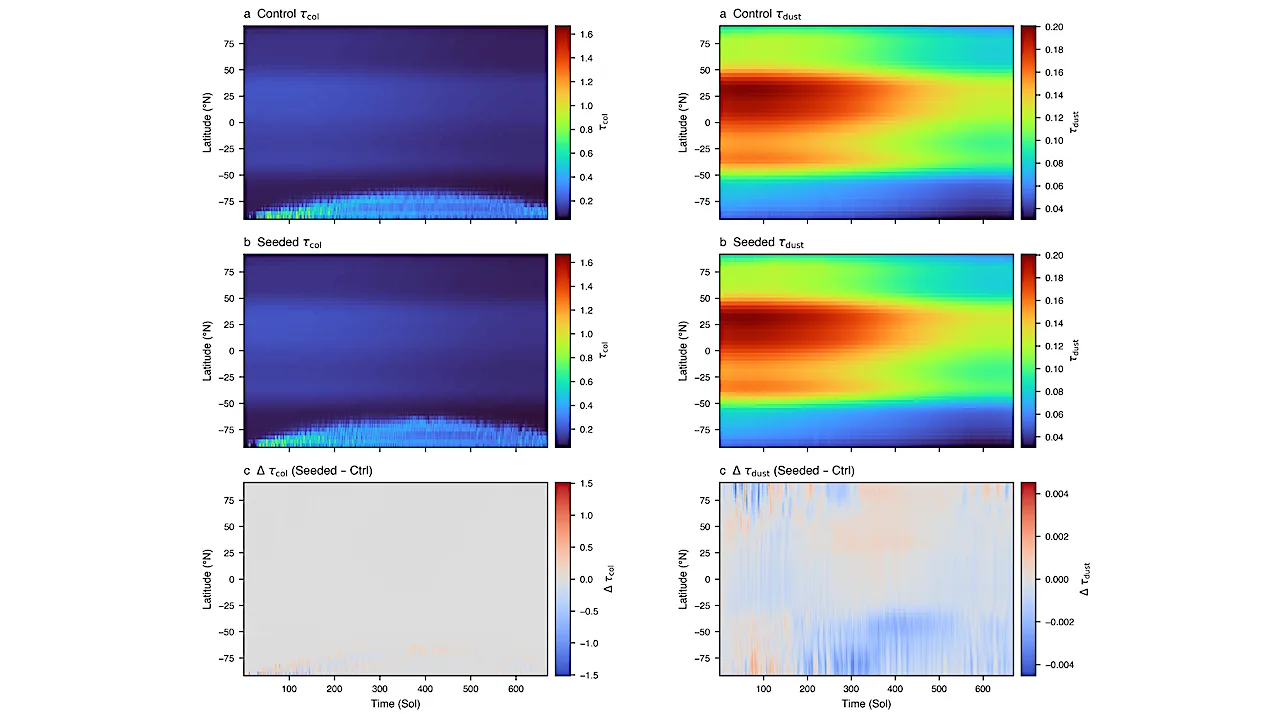
Researchers have employed three-dimensional global climate simulations to examine how synthetic warming could affect Mars’ atmosphere and seasonal cycles. These advanced models track changes in atmospheric optical depth and temperature throughout a Martian year, providing unprecedented detail on the planet’s potential climate dynamics under artificially enhanced warming conditions.
The simulations contrast a control scenario with one where atmospheric properties are altered to increase thermal absorption, effectively mimicking warming. This approach allows scientists to observe how dust and other particulates influence Mars’ energy balance and atmospheric opacity over hundreds of sols (Martian days).

Results reveal that synthetic warming dramatically extends the duration and intensity of atmospheric dust loading, leading to a sustained increase in optical depth. This, in turn, modifies surface temperatures and seasonal weather patterns, potentially creating a more temperate environment for much of the year. The study sheds light on Mars’ climate sensitivity and offers a valuable framework for evaluating future terraforming concepts or robotic mission planning.