

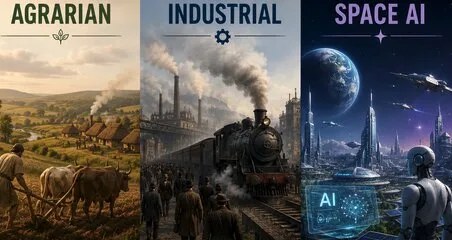
The global economy has undergone transformative shifts driven by technological revolutions that drastically changed growth rates and industrial scale. For centuries before the Industrial Revolution, economic growth was nearly stagnant, with annual increases in GDP barely above zero. This changed dramatically with the advent of industrialization, which boosted annual GDP growth rates by 10 to 20 times compared to the agrarian period.
The Industrial Revolution marked a critical turning point by introducing mechanized production methods and transportation innovations. Early steam engines allowed speeds of 20 to 30 miles per hour, extending travel to hundreds of miles daily, compared to weeks-long journeys relying on animal and sailing transport. As infrastructure and technology progressed into the 20th century, peak travel speeds and distances exploded—from early automobiles on rough roads averaging under 60 miles per day, to interstate highways supporting speeds of 50 to 70 miles per hour and commercial jets routinely covering thousands of miles daily. Looking ahead, proposed orbital point-to-point travel could shorten intercontinental trips to under an hour, hinting at further economic acceleration.

Corresponding with these transportation leaps, the global economy grew from under $1 trillion before industrialization to more than $120 trillion today. Industry giants now surpass the GDP of entire nations from the mid-20th century. For example, several leading technology companies currently have valuations exceeding the world’s GDP in the early 1970s, illustrating how corporations have outpaced previous economic benchmarks.
Historic disruptions have shown that GDP growth rates are far from stable. During World War II, the U.S. economy doubled in output over a few years, achieving growth rates that far exceeded peacetime periods. This reinforces the idea that targeted investment and technological innovation can temporarily boost economies beyond long-term trends. Current massive investments in artificial intelligence could have a similar or greater impact on productivity and growth, with some projections suggesting sustained GDP increases of 15 to 30 percent annually—significantly higher than growth rates during the Industrial Revolution or postwar boom periods.
This pattern challenges assumptions that large companies cannot outgrow the economy or that world GDP growth must remain slow and steady. Instead, just as the Industrial Revolution irreversibly expanded global wealth and capacity, the ongoing AI and space technology revolutions may trigger a new era of rapid economic transformation.