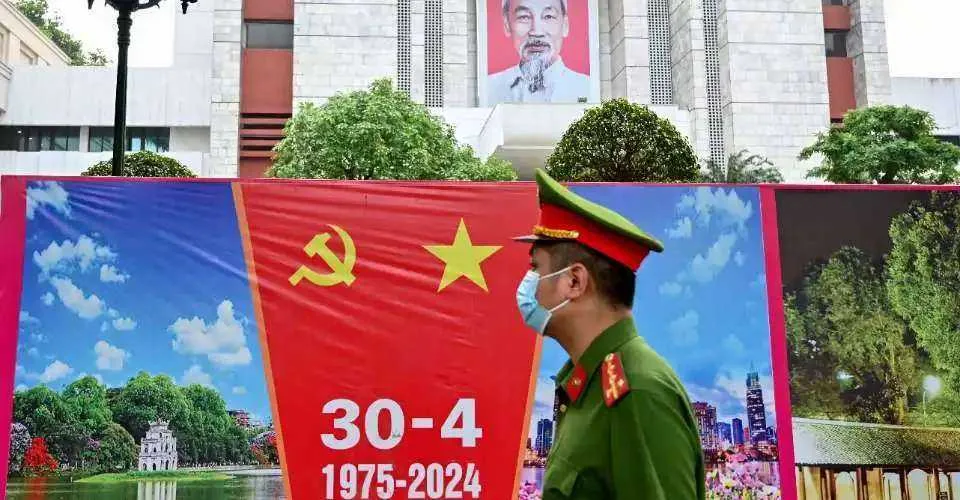
Vietnam is undergoing a subtle but deliberate shift in how it describes the war that ended in 1975, with traditionally sensitive terms appearing with increasing frequency across public discourse. Terms such as "Vietnam War" and "Republic of Vietnam" — once avoided in official settings — are now surfacing in newspapers, academic writing, and mainstream media outlets, marking a departure from the standard official designation of "Resistance War Against the United States."
For nearly five decades, Vietnam's state apparatus maintained strict control over the naming and framing of the conflict. The official term "Resistance War Against the United States" emphasized defense and national legitimacy, while alternative expressions like "ngụy quyền Sài Gòn" (the puppet regime in Saigon) carried openly dismissive connotations. The gradual replacement of such politically charged language with more neutral phrasing — such as "the government of the Republic of Vietnam" — signals a shift away from explicit ideological judgment toward simple identification.

The change extends beyond terminology into cultural representation. Recent Vietnamese literary and visual works have begun portraying figures associated with the Republic of Vietnam in more humanized, less ideologically rigid ways. Soldiers from opposing sides increasingly appear as individuals shaped by circumstance rather than as moral abstractions representing political labels. Some state-backed productions have depicted opposing soldiers with less caricature than in previous decades, reflecting a broader cultural movement from portraying "sides" to portraying people.
Scholars point out that naming is never neutral. Historian Christopher Goscha has noted that the same conflict receives different names depending on perspective, with those names shaping how history itself is understood. The growing presence of different terminology reflects what Keith Taylor describes as multiple, sometimes competing ways of remembering the war — a tension between the established national narrative and increasingly diverse understandings of the past.
The shift remains carefully controlled in formal media but generates tension on social platforms. On social networks, the use of terms like "Republic of Vietnam" can trigger heated debates, with single phrases sparking hundreds of comments. In these spaces, language functions as more than communication; it becomes a signal of identity and, occasionally, a source of division.
Broader geopolitical developments appear to underpin this linguistic evolution. Relations between Vietnam and the United States have steadily improved across trade, education, and diplomacy. The Vietnamese diaspora in America contributes through investment and cultural exchange, creating pressure for a shared vocabulary that can be understood across different communities.
This transformation is not a dramatic historical rewriting. No official declarations have redefined the past, and educational curricula remain largely unchanged. Instead, the shift unfolds quietly: a term appearing in a newspaper, different phrasing in a research paper, a softer tone in public discussion. Individually minor, together these changes point to a broader evolution in how Vietnam engages with its war and its past.