

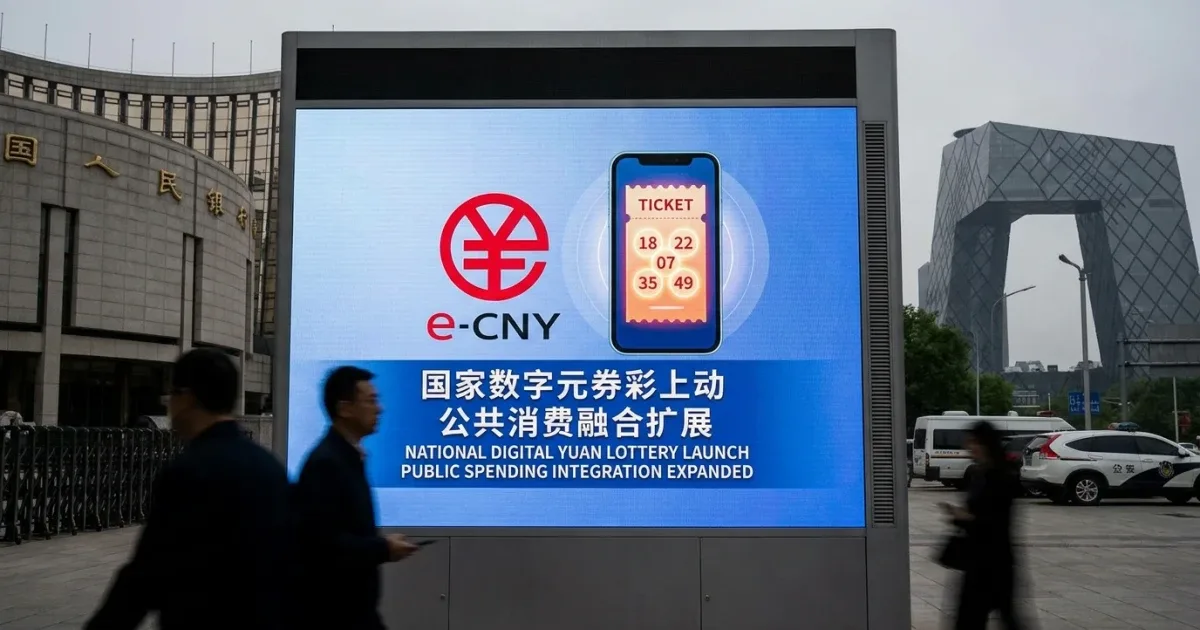
China has taken significant steps to promote its digital currency, the digital yuan (e-CNY), by linking it to public initiatives such as lottery giveaways and government fiscal disbursements. This approach intends to increase public engagement and normalize the use of the digital currency in daily financial activities.
Since the initial pilot programs in major cities, local governments have launched lottery campaigns that award millions in digital yuan to users who download the official wallet app. These prize distributions, held in cities including Shenzhen and Suzhou, allow recipients to spend their winnings at selected merchants, embedding e-CNY more deeply into consumer transactions.

Beyond consumer incentives, the digital yuan has moved into the public finance realm. Some provincial governments now pay portions of employee salaries, social benefits, and business subsidies directly in the digital currency. This marks a deliberate effort to use the e-CNY for routine government payments, signaling official backing and the integration of the currency into public spending mechanisms.
The digital yuan’s adoption has expanded rapidly, with over 360 million individual wallets reportedly active across pilot regions. Transaction volumes surpassed 1.8 trillion yuan last year, reflecting a growing, though still experimental, presence in retail, business, and government service payments. While pilot schemes also explore cross-border trade applications, domestic use remains the main focus.
Despite these advances, daily usage of the digital yuan still falls short of popular mobile payment platforms like Alipay and WeChat Pay. Many users continue to treat e-CNY as a novel feature rather than a necessary payment tool. By embedding the currency in government lotteries and regular fiscal programs, Chinese authorities aim to build habits and gradually increase practical acceptance.