

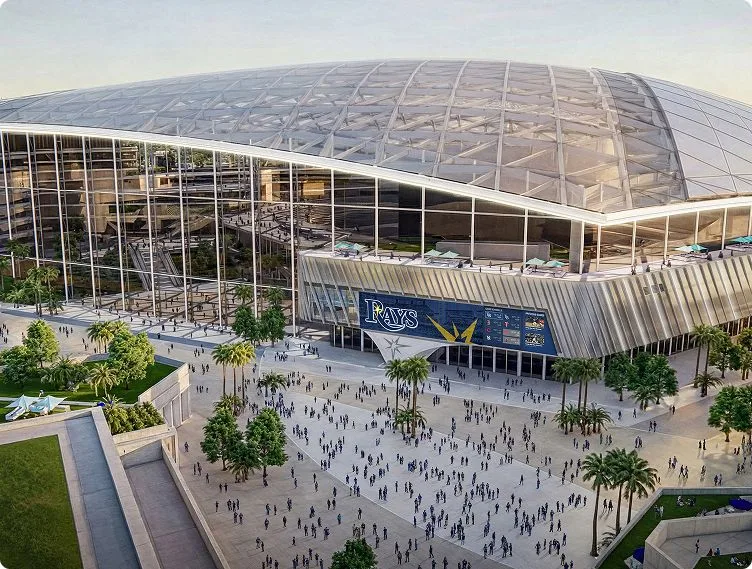
Hillsborough County and Tampa city leaders recently approved a memorandum of understanding (MOU) that advances the Tampa Bay Rays’ ambitious proposal for a new stadium and surrounding development. This milestone has encouraged state lawmakers to allocate $50 million toward nearby college renovations tied to the project, while the local college agreed to lease land for the stadium and an entertainment district at a nominal rate for nearly a century.
County Chair Ken Hagan, who also serves on the Tampa Sports Authority Board, described the MOU as the most substantial progress in the effort to secure a permanent Rays home. However, he stressed that the stadium is only a fraction of a much larger plan. The ballpark itself is estimated to cost about $2.3 billion, but the full mixed-use development could total up to $10 billion, dwarfing other large-scale local projects such as Water Street and Midtown Tampa. Hagan compared the envisioned district to The Battery Atlanta but noted this development would span approximately 55 more acres, making it one of the region’s biggest.

Under the MOU, public funding is capped at just under $1 billion, with Hillsborough County committing up to $796 million and Tampa and its community redevelopment agency together contributing up to $180 million. The funding approach avoids raising taxes or fees by not bonding community investment tax revenue as initially considered, opting instead to spread CIT revenue over time to safeguard taxpayers and the county’s credit rating.
The next phase involves intensive negotiations over several critical agreements addressing financing, land use, relocation of existing entities, and project obligations. Hagan aims to present completed contracts to local governing bodies by mid-July. He also highlighted the transformative potential of the project for the Drew Park area, which has struggled with redevelopment for decades. The plan aims to revitalize the region economically and socially, producing benefits that would be difficult to achieve otherwise.
Despite these approvals and endorsements, some stakeholders express caution. Former Mayor Bill Carlson has warned that, although the project shows promise, the deal is far from certain. Finalizing consensus among all parties will require navigating complex negotiation phases, and some vote swings remain possible. As the process unfolds, both supporters and skeptics watch closely to see if this major development vision will move beyond planning into reality.