

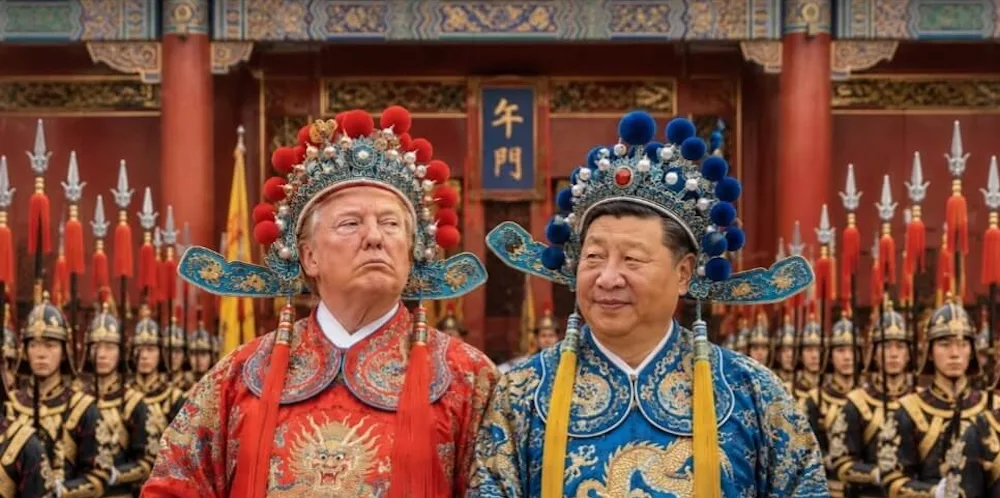
President Trump’s visit to China stood out for its impressive pageantry but also for the nuanced layers hidden beneath the polished appearances. His three-day trip unfolded much like a traditional Peking Opera, full of ceremonial splendor, yet marked by a careful choreography that kept key realities beneath the surface.
Throughout the visit, President Trump referred to President Xi Jinping as a close friend, recalling over a decade of acquaintance and cooperation on various issues. Despite this public warmth, the trip maintained a cautious distance. For instance, strict security measures prohibited all members of the U.S. delegation from carrying personal electronic devices, such as cell phones and laptops, to avoid data interception—a reflection of the underlying mistrust between the two nations.

The ornate protocols of the visit included moments like the presidents admiring ancient trees in Beijing’s Garden of Heaven, symbolic gestures highlighting tradition and continuity. Yet this imagery contrasted starkly with the core political differences between the two countries. While the United States prides itself on freedoms dating back to the 18th century, China sustains a firm Communist governance that shaped its modern political landscape through revolutionary upheaval.
The carefully managed itinerary underscored a balance between diplomacy and caution. Despite friendly remarks, the delegation’s restricted technology use illustrated unresolved concerns over espionage and data security, a significant hurdle in Sino-American relations. The visit’s theatrical elements masked a more complex narrative of cooperation tempered by enduring strategic competition.
In summary, while the visit delivered on visual spectacle and a rhetoric of friendship, it also revealed the constraints and challenges underlying diplomatic ties, with technology restrictions, ideological gaps, and guarded interactions defining a visit that was less a breakthrough than a carefully staged performance.