

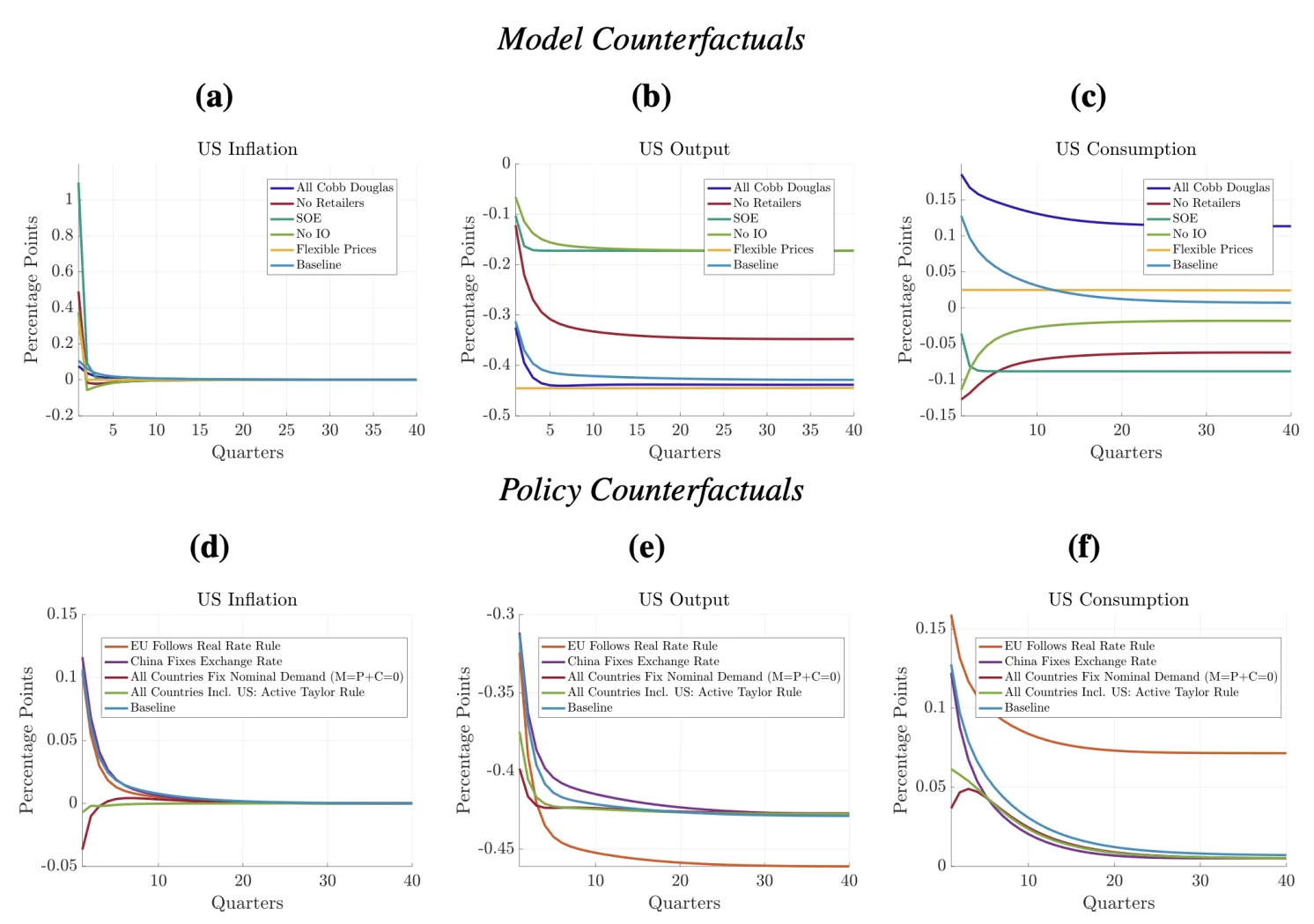
Recent research has developed a comprehensive economic model showing that tariffs do not simply affect trade flows temporarily but generate sustained macroeconomic consequences worldwide. By integrating global production networks and financial market imperfections into an open-economy New Keynesian framework, the study demonstrates how tariffs function simultaneously as supply and demand shocks—with effects shaped by price rigidity and monetary policies both domestically and abroad.
This advanced model challenges conventional analyses focused on long-run welfare by accounting for the complexities of modern economies, where interconnected firms and sectors across countries experience delayed price adjustments, especially in services. It emphasizes that transitory tariff measures can produce enduring inflation increases, significant reductions in output, and widespread cross-border economic repercussions even without retaliatory actions.

At the core of the framework is a set of five key equations: an IS curve representing aggregate demand, a producer-price Phillips curve capturing inflation dynamics, a consumer price index (CPI) definition, an uncovered interest parity (UIP) condition describing exchange rate behavior, and a balance-of-payments equation tracking international financial flows. This structure allows the model to reveal two critical insights. First, tariffs create a “risk-sharing wedge” due to incomplete financial markets, redistributing wealth internationally through shifts in terms of trade, exchange rates, and net foreign asset positions. Second, the integration of production networks shows how disruptions propagate through global supply chains, amplifying initial shocks far beyond the imposing economy.
The research underscores that tariffs impact economies not only by raising costs for importers and exporters but also by altering embedded financial relations and inter-industry dependencies. Traditional models that assume flexible prices and perfect markets tend to underestimate these complex short- and medium-term effects.
This model gains additional relevance considering recent rises in tariff use as geopolitical tools, such as the escalation of U.S. tariffs noted in 2025, which broadly disrupted global trade patterns and supply chains without immediate retaliation. By incorporating nominal price rigidities and global monetary policy responses, the framework explains how these trade barriers induce persistent inflationary pressures and output declines, influencing both the imposing and trading partner countries.
Such findings suggest policymakers need to reconsider the assumed transient nature of tariff impacts. Even brief tariff interventions can trigger long-lasting distortions in inflation, output, and international financial positions due to the intricate interplay of global production and finance networks. The model provides a more realistic assessment of tariffs’ consequences, especially in an interconnected economic landscape marked by delayed price adjustments and incomplete markets.