

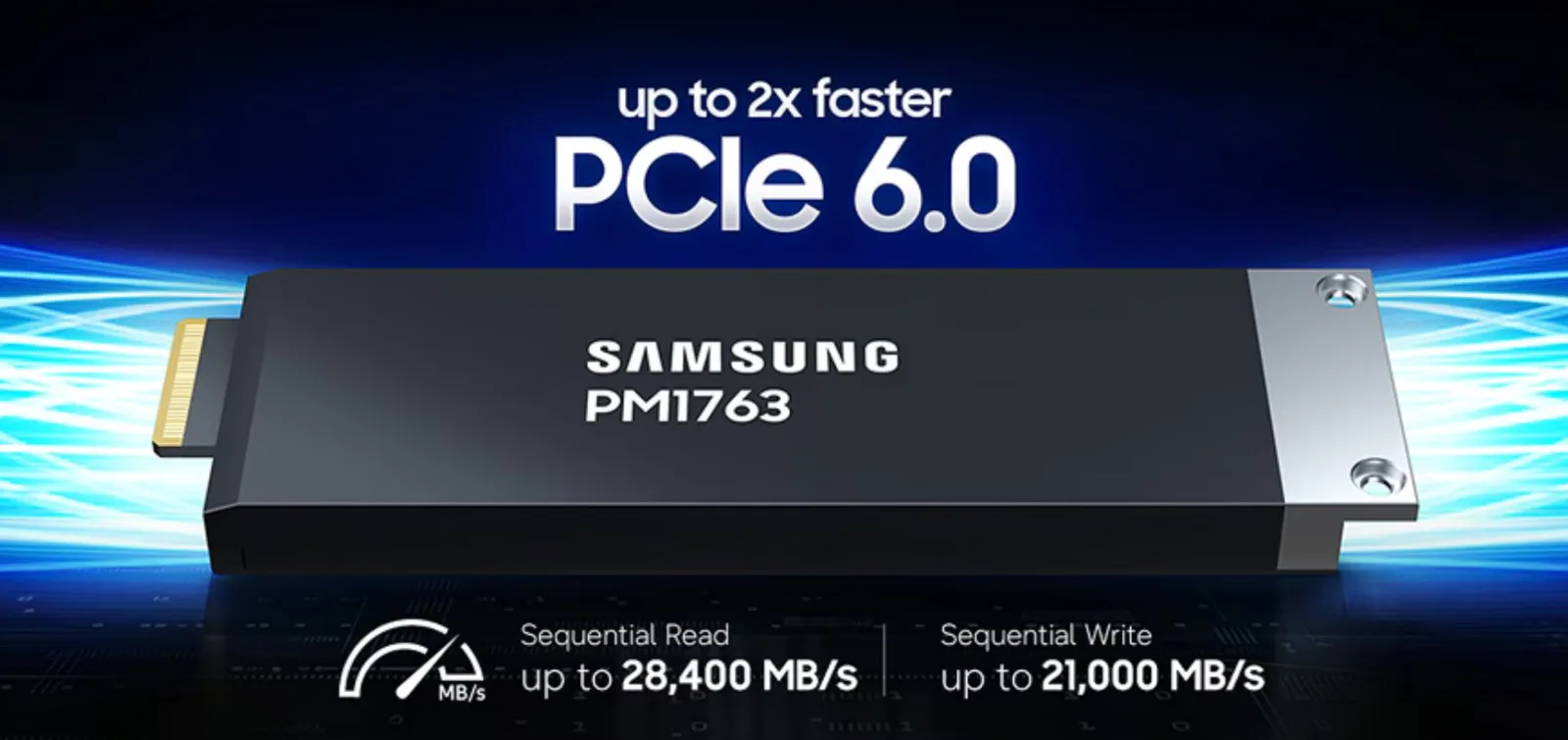
Samsung has initiated large-scale production of the PM1763, the world’s first enterprise solid-state drive to use the PCIe 6.0 interface. This latest SSD is engineered to meet the soaring data demands of next-generation artificial intelligence (AI) and high-performance computing (HPC) servers, including NVIDIA’s Vera Rubin platform.
At the heart of this innovation is Samsung’s integration of 9th-generation V-NAND technology paired with a newly developed 4-nanometer controller. These advancements bring enhanced data transfer rates and improved power efficiency. The PM1763 is available in 4TB, 8TB, and 16TB capacities, with the flagship 16TB model achieving sequential read speeds up to 28,400 MB/s and write speeds reaching 21,900 MB/s—more than double the performance of its predecessor, the PM1753.

Such bandwidth accelerates AI workflows significantly. For instance, transferring a 40GB large language model would take roughly 1.4 seconds, reducing latency between processors and accelerators and boosting overall system throughput. The PM1763 also supports liquid-cooled environments through a direct-to-chip (D2C) cooling mechanism, enabling consistent performance under sustained, intensive workloads.
Beyond speed, Samsung has enhanced energy efficiency, with the new drive consuming less than half the power compared to earlier models. This improvement addresses the operational costs crucial to data centers that run AI infrastructures around the clock. Optimizing storage solutions like the PM1763 aligns with the growing hardware needs of AI, where rapid, reliable data access is essential to training and inference processes.