

Uranium ditelluride (UTe2), a uranium-based superconductor, exhibits a rare phenomenon where it loses and then unexpectedly regains zero electrical resistance under extraordinarily high magnetic fields. While most superconductors lose their ability to conduct without resistance under strong magnetic fields, UTe2 first ceases superconductivity at about 10 Tesla, then reenters this state between 40 and 70 Tesla—fields intense enough to crush typical physical behavior.
Scientists from the Institute of Science and Technology Austria (ISTA) investigated this puzzling behavior to understand the cause of the so-called “reentrant superconductivity.” Contrary to previous assumptions that magnetism influences unconventional superconductors, UTe2 itself does not exhibit conventional magnetic properties, making its response to magnetic fields all the more perplexing.

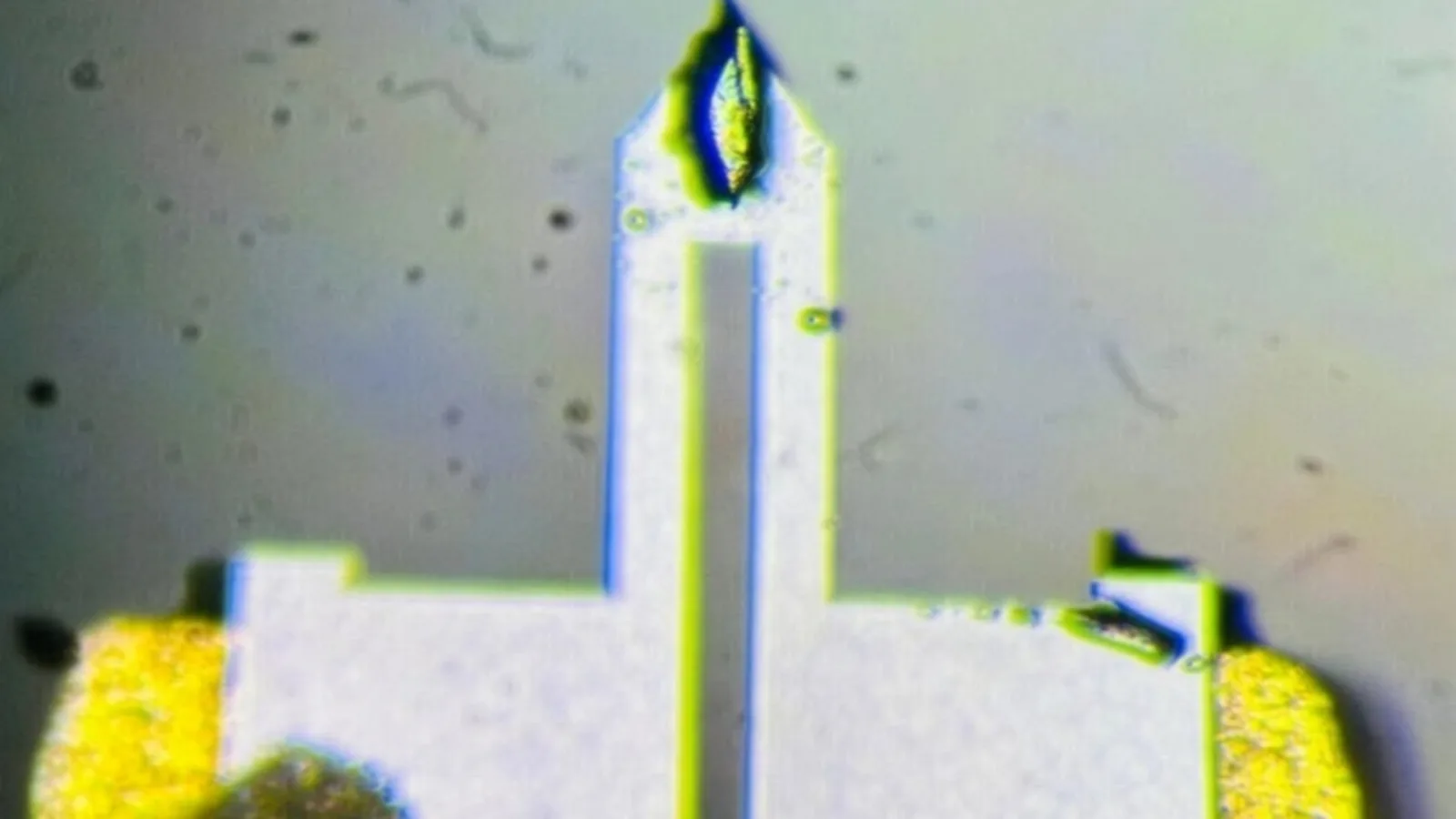
The research team subjected UTe2 samples to ultra-high pulsed magnetic fields reaching up to 60 Tesla within fractions of a second. To examine the internal magnetic behavior, they devised an innovative experiment involving mechanical oscillations. By placing the crystal on a cantilever—akin to a tiny lever—they induced a controlled “shake,” simulating a rapid oscillation of the magnetic field’s direction from the crystal’s perspective. This approach allowed the researchers to measure the material’s transverse magnetic susceptibility, a property describing how the material magnetizes perpendicular to the applied field, under previously inaccessible conditions.
Their findings identified a strong region of transverse magnetic susceptibility in UTe2 that likely acts as a coupling mechanism for electrons, effectively “gluing” them together to reestablish superconductivity at high fields. This discovery sheds light on how UTe2’s electrons overcome the destructive influence of intense magnetic forces to restore the superconducting state.
The study not only deepens understanding of quantum materials and electron pairing mechanisms but also challenges long-standing assumptions about the interplay between magnetism and superconductivity. UTe2’s unique behavior may influence future research in designing materials that function as superconductors under extreme conditions, potentially impacting technological applications in fields like medicine, electronics, and quantum computing.