

The Federal Aviation Administration (FAA) has granted approval for SpaceX to conduct two test flights of its Starfall reentry capsules, marking a significant step toward developing spacecraft aimed at advancing commercial manufacturing in orbit. These uncrewed capsules are intended to support both rapid point-to-point cargo delivery via space and serve as a foundation for a self-sustaining in-space manufacturing economy.
According to FAA documents, which were publicly summarized at the end of May, Starfall seeks to offer accessible microgravity and vacuum environments for research and production, with the capability to return experiments safely to Earth. These capsules are a proposed successor to facilities like the International Space Station, potentially enabling large-scale commercial manufacturing operations in orbit.

The FAA’s environmental assessment clears the way for two Starfall capsules to be launched atop Falcon 9 or Starship vehicles, either achieving orbit or flying directly along suborbital trajectories. The capsules then would reenter Earth’s atmosphere and splash down in the Pacific Ocean, roughly 1,300 kilometers offshore from California and Mexico, where recovery teams will retrieve the spacecraft for reuse and analysis.
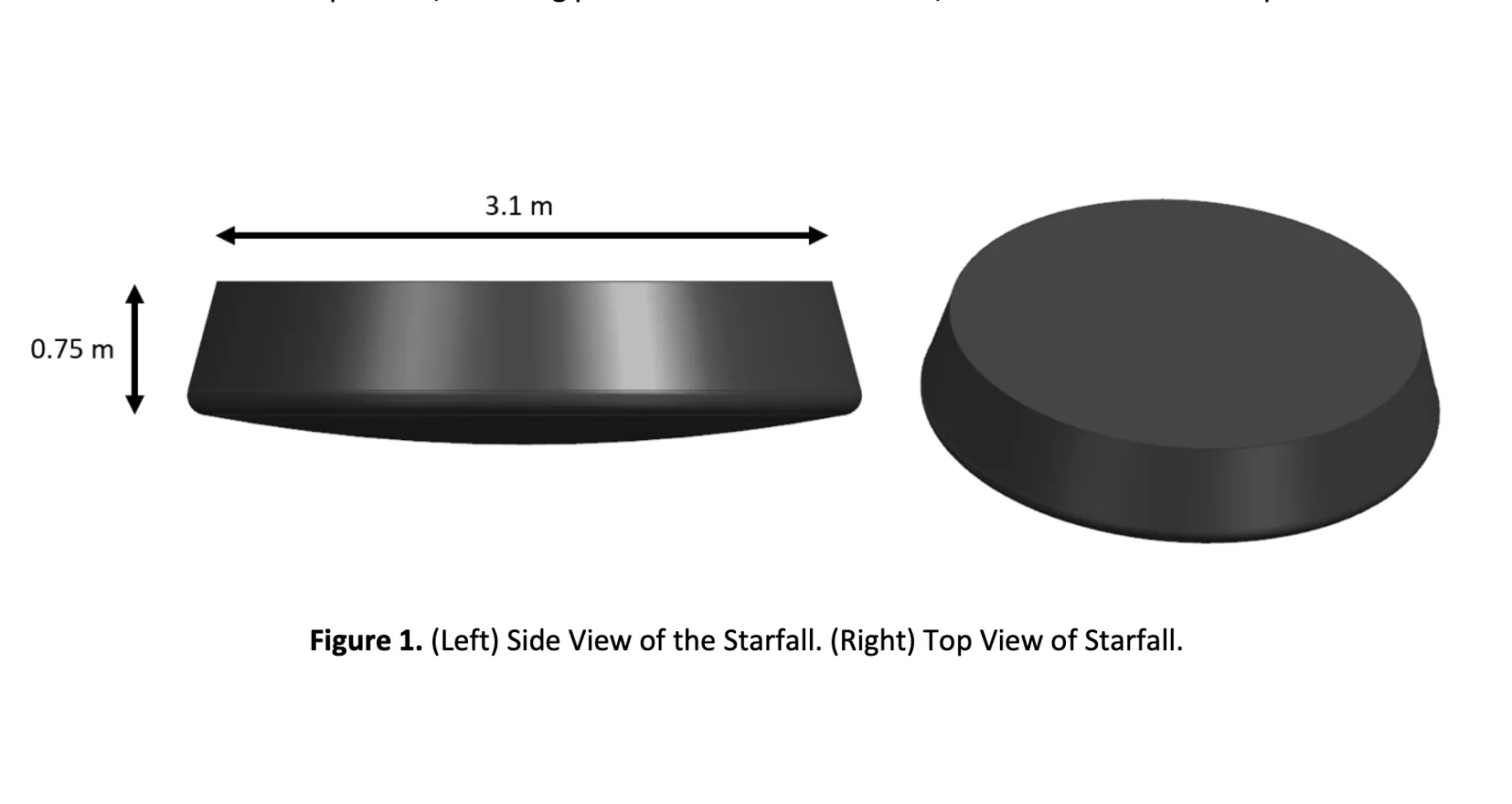
Starfall capsules feature a distinctive disk-like design, measuring 0.75 meters in height and 3.1 meters in diameter at the top. The vehicle consists of a two-part structure: an aluminum top plate wrapped in thermal protection, weighing about 1,400 kilograms, and a carbon-fiber heat shield weighing around 700 kilograms. The shield houses cold-gas thrusters powered by onboard nitrogen tanks for attitude control, but the capsule lacks any propulsion system for deorbiting independently.
Upon reentry, the heat shield detaches just before splashdown. The descent is slowed by a sequence of parachutes—a main parachute accompanied by pilot and drogue chutes—to ensure a controlled landing in the ocean. The FAA’s decision confirms no significant environmental impact from these tests, noting recovery operations will efficiently retrieve all capsule components from the water.
The agency’s approval explicitly covers only these initial two flights, with no current authorization for further missions. However, the documents frame Starfall as a prototype for a broader class of spacecraft geared toward scalable commercial applications in space manufacturing and rapid delivery of critical cargo around the globe.