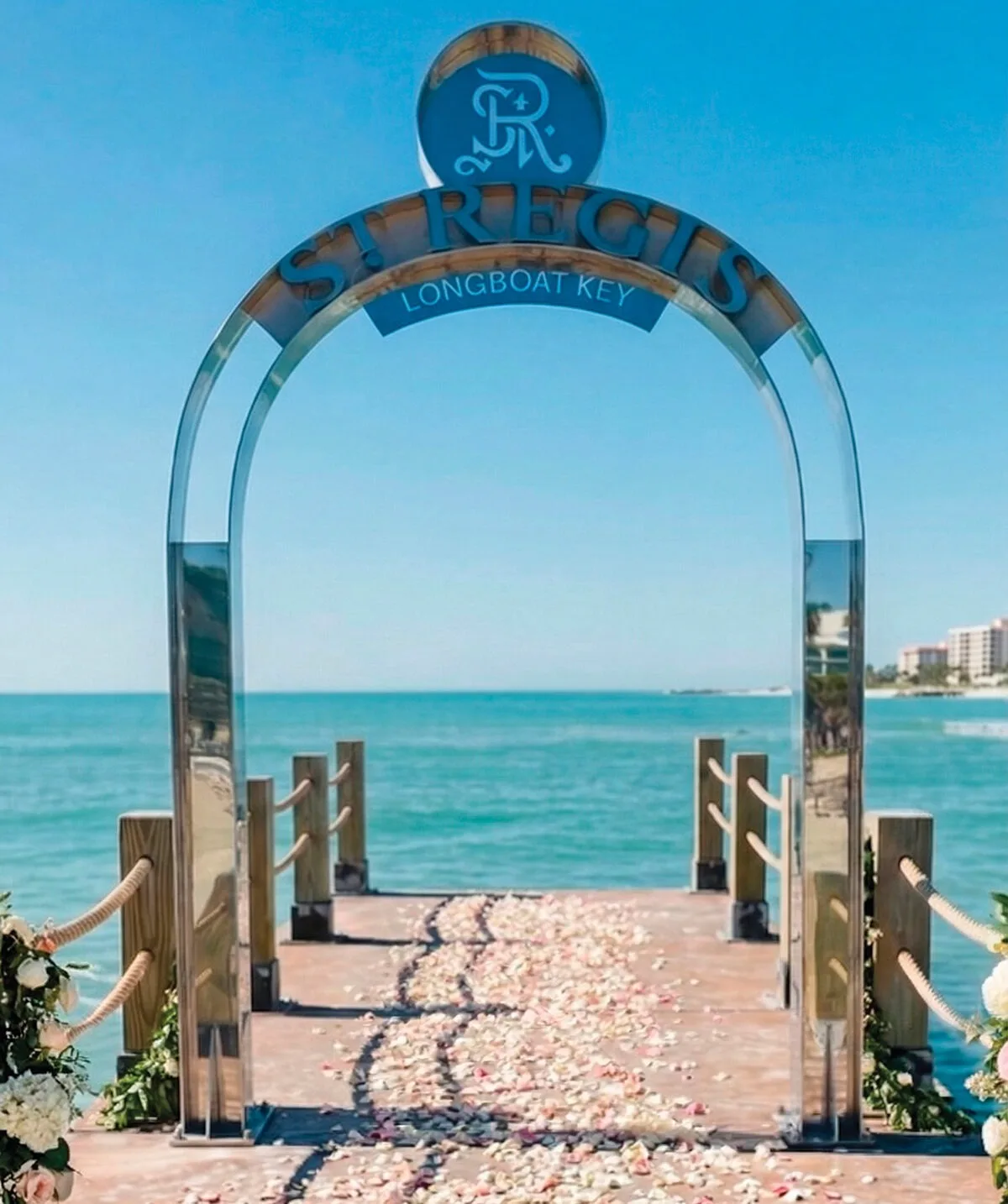
The 14-foot metallic arch bearing the St. Regis crown logo has stood draped in fabric since town code enforcement officers arrived, waiting for the Longboat Key Town Commission to decide its fate on Monday, May 4. The structure, installed in August 2025 on a boardwalk extending into the Gulf of Mexico, lacks the town permit required by local law, though the State of Florida approved it when developer Unicorp National Developments applied for groin repair permits through the Department of Environmental Protection.
What appears to be a straightforward zoning dispute carries far greater weight. Buried in footnote two of Unicorp's January 23, 2026, application letter is an explicit reservation of rights: if the Town Commission denies the ordinance amendments, the company will pursue litigation in circuit court to challenge the town's authority to regulate the structure at all. The Commission is not simply deciding whether the arch belongs on Longboat Key's beach. It is choosing between legislative resolution and an expensive court battle against a well-resourced developer.

Town staff initially rejected the arch as violating the town's Sign Code, advising Unicorp to seek code amendments rather than a traditional permit. Two companion ordinances now before the Commission would create narrow exceptions to both the Zoning Code and Sign Code. Ordinance 2026-07 would allow a single archway structure with an identifying sign seaward of the Erosion Control Line on a privately owned groin with pedestrian access, subject to strict construction standards: maximum 14 feet in height, columns no larger than 8 by 8 inches, capable of withstanding 150-mph winds, and unilluminated. Ordinance 2026-08 would create a new "Private Groin Sign" category in the Sign Code with identical restrictions. Both ordinances must pass for either to take effect.
The ordinances are carefully drafted to navigate constitutional constraints. A 2015 U.S. Supreme Court decision in Reed v. Gilbert established that sign codes must be content-neutral, striking down regulations that classify signs by their message. Rather than explicitly authorizing tourism advertising, Town Attorney Maggie Mooney framed the sign as "content-neutral ownership identification for public safety purposes" — helping emergency responders locate the structure and identifying the private entity responsible for the groin. This language removes references to hotels, motels, or tourist amenities that appeared in earlier drafts.
The Planning and Zoning Board recommended denial by votes of 4-1 and 3-2 in March. Board members questioned the safety rationale. Board Member S. Jay Plager, a retired federal judge, said he had written "BS" in the margin when reading the public safety justification but stated he would have approved the arch on aesthetic grounds regardless. Commissioner BJ Bishop has publicly committed to voting for removal, meaning developer Chuck Whittall would need four of the remaining six commissioners to pass both ordinances.
Whittall has expressed confidence. From the Sebring International Raceway, he characterized the Planning Board's comparison of the arch to a "Jersey Shore" commercialized landscape as "ridiculous and unfair," noting the ordinance applies only to privately owned groins with pedestrian walkways—of which one exists on the island. He described the arch as integral to the wedding experience and open to the public for photographs. He cited the resort's inaugural season as "tremendously successful" with occupancy and rates "top of market," and reported that nearby merchants have seen business increases.
An additional factual problem mars the application record. In her notarized application letter, Unicorp's attorney, Brenda L. Patten, stated the arch "withstood hurricanes Milton and Helene without coming loose or causing damage." Both hurricanes struck the Gulf Coast in September 2024. The arch was installed in August 2025, nearly a year later. At the March planning board hearing, Whittall apologized and said he had been misinformed by his team. The false claim remains in the sworn, notarized document in the town's permanent public record.
The vote Monday encapsulates a fundamental tension: whether Longboat Key's famously strict regulatory system applies equally to all, or whether a sufficiently large economic contribution buys flexibility to rewrite rules around completed facts. The community has deliberately preserved its barrier island character through decades of development pressure. The St. Regis represents genuine economic benefit—employment, tax revenue, and international visibility. Both claims are legitimate. The Commission must now choose between enforcing the system that created Longboat Key's identity, or resolving the dispute through negotiated amendment. If it denies the ordinances, Whittall's attorney has made clear the case moves to circuit court.
The meeting is Monday, May 4, 2026, at 1:00 PM at Town Hall, 501 Bay Isles Road. The ordinances are Agenda Items 6-C and 6-D. If both pass first reading, a second reading and final public hearing is scheduled for June 1, 2026. The meeting is live-streamed at longboatkey.org.