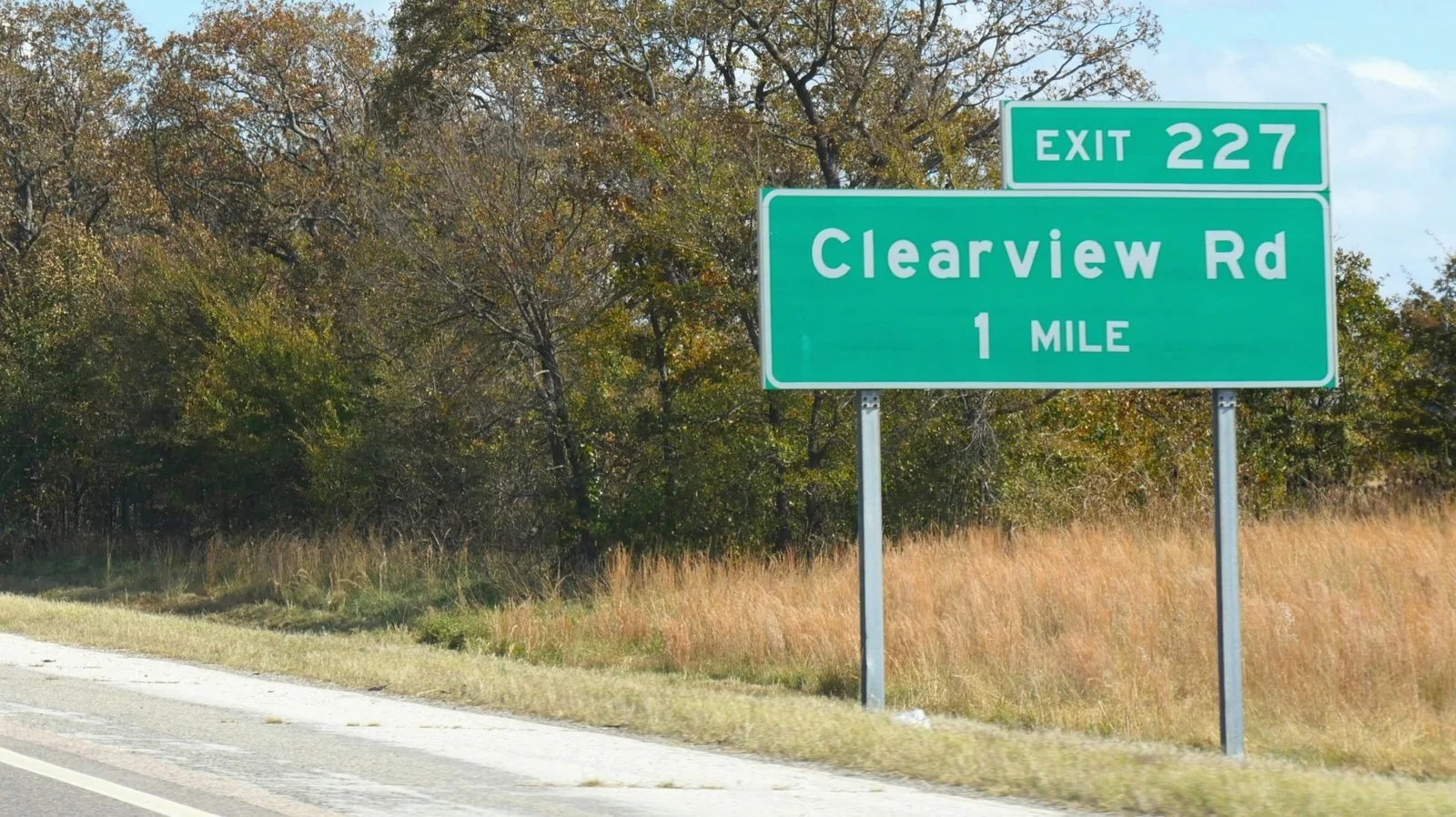
American highway signs display two competing typeface systems, reflecting an unresolved federal design dispute that has stretched across multiple administrations. Highway Gothic, adopted by the Federal Highway Administration beginning in 1948, remains the dominant font on road signs nationwide, though Clearview has gained approval for use on certain state highway systems.
The push toward uniform signage began after President Dwight D. Eisenhower signed the Federal-Aid Highway Act in 1956. Before standardization, road signs across the country featured a chaotic mix of fonts, shapes, and colors. As highway speeds increased significantly, the FHWA recognized a need for clearer, more legible signage and turned to Highway Gothic, a modified version of the traditional Gothic typeface found in standard font libraries.

The emergence of reflective sheeting on road signs introduced a technical challenge that Highway Gothic could not adequately address. The reflective material created a visual phenomenon called "halation"—an apparent fuzziness surrounding brightly illuminated lettering that reduced readability, particularly at high speeds and in nighttime conditions. This problem prompted the development of an alternative.
Designers James Montalbano and Donald Meeker created Clearview in the 1990s through their respective firms, Terminal Design, Inc. and Meeker & Associates. The new typeface flattens the angled elements found in Highway Gothic letters such as l, d, t, and k. Clearview also features larger interior spaces within letters to reduce light-based distortion, and its lowercase letters are proportionally taller than those in Highway Gothic—nearly as tall as capital letters.
The FHWA approved Clearview for road sign use in 2004, but implementation remained limited. With approximately 4.2 million miles of American highways in existence, a complete nationwide overhaul would prove prohibitively expensive. States were permitted to adopt Clearview for new or replacement signage on a voluntary basis.
The regulatory landscape shifted unexpectedly in 2016 when the FHWA withdrew its approval for Clearview. However, the agency reversed course just two years later, reinstating approval in 2018 under the condition that signs using Clearview adhere to existing design standards. Today, the choice between Highway Gothic and Clearview depends on individual state decisions, ensuring that America's road signs will remain typographically diverse for the foreseeable future.