

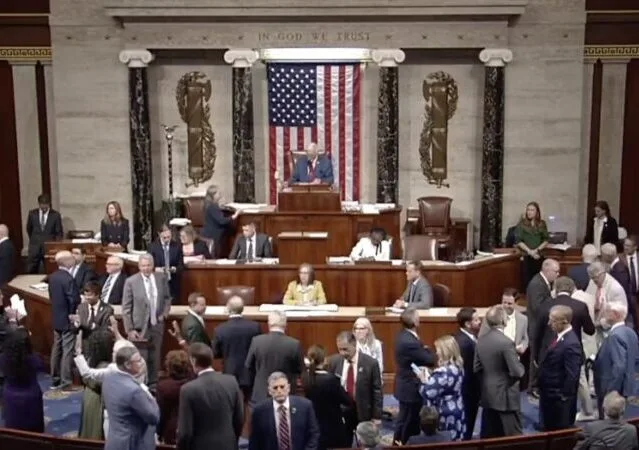
The House of Representatives passed a resolution aimed at ending the U.S. war in Iran, winning a narrow 215-208 vote. Four Republicans broke ranks with their party to join unanimous Democratic support for the measure, signaling growing skepticism within Congress about continuing military engagement in the region.
The Republicans who backed the resolution were Thomas Massie, Brian Fitzpatrick, Tom Barrett, and Warren Davidson. This marks the first time the House has passed this measure after multiple prior attempts, two of which were led by Democrats and one introduced by Massie shortly after the war began.

Despite the vote’s symbolic nature, the House’s resolution reflects mounting political pressure ahead of upcoming elections. Concurrent resolutions like this one express Congressional intent but do not require presidential approval and carry no legal force. However, the Senate’s version is a joint resolution, which would need to be signed by the President to become law. Given that President Trump is expected to veto it, the resolution’s practical effect remains uncertain.
The passage drew cheers from Democrats on the House floor but sparked criticism from opponents who described the vote as politically motivated and shortsighted. Some officials warn the divide may embolden Iran’s regime, which has used bipartisan dissent as propaganda to paint the U.S. as divided and reluctant to maintain its military posture.
Iran has suffered significant losses in leadership and infrastructure but continues to harness public weariness of the conflict and rising domestic costs, such as high fuel prices, to undermine U.S. resolve. Experts note that, similar to tactics used by Hamas, the Iranian government leverages political opposition within the U.S. and sympathetic media narratives to win the battle for public opinion.
President Trump responded swiftly on social media, asserting that his political opponents prioritize undermining his administration’s successes over national security. He framed the vote as a betrayal that favors foreign adversaries rather than American interests.