

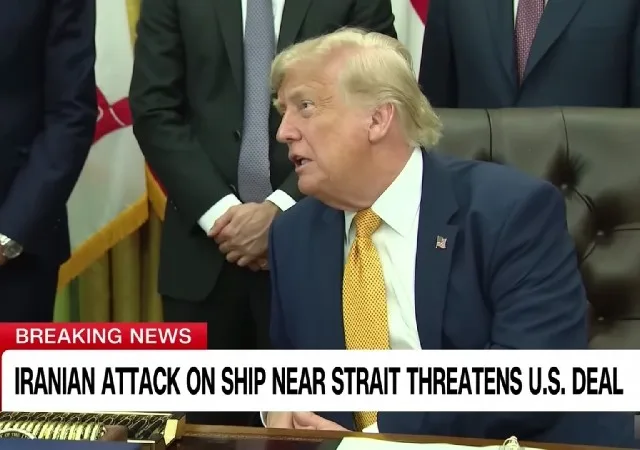
Iran significantly breached the recently established ceasefire by conducting attacks on shipping vessels in the Strait of Hormuz while simultaneously launching drone strikes against Bahrain. This marks a clear escalation that threatens to derail ongoing efforts to negotiate a lasting peace between Iran and the United States.
On Saturday, a tanker suffered damage to its bridge after being hit by a projectile while transiting the strategic Strait of Hormuz, according to the British maritime security agency UKMTO. All crew members aboard the vessel were reported safe. This incident follows a similar attack earlier in the week when an Islamic Revolutionary Guard Corps (IRGC) drone targeted a Singapore-flagged cargo ship, forcing the United Nations to suspend evacuation plans for trapped vessels and their crews.

The U.S. Central Command responded to Iran’s provocations by striking Iranian missile and drone storage sites as well as coastal radar installations in the region. Iran’s IRGC claimed these U.S. attacks were met with retaliatory strikes on military bases in Bahrain. These tit-for-tat exchanges highlight the volatile nature of the Persian Gulf, a critical corridor for global maritime trade.
President Donald Trump condemned Iran’s actions as a "foolish violation" of the ceasefire, emphasizing that Iran deployed several one-way attack drones against ships navigating the waterway. He warned that the U.S. would respond decisively to further breaches. These developments come shortly after a ceasefire agreement had taken effect, underscoring the fragility of the diplomatic framework and the persistent risks of escalation in the region.
The Strait of Hormuz remains a focal point of tension due to Iran’s growing assertiveness and its strategic position controlling one of the world’s busiest maritime chokepoints. The recent attacks and ensuing military responses illustrate the dangers facing international shipping and the broader consequences for regional and global security.