

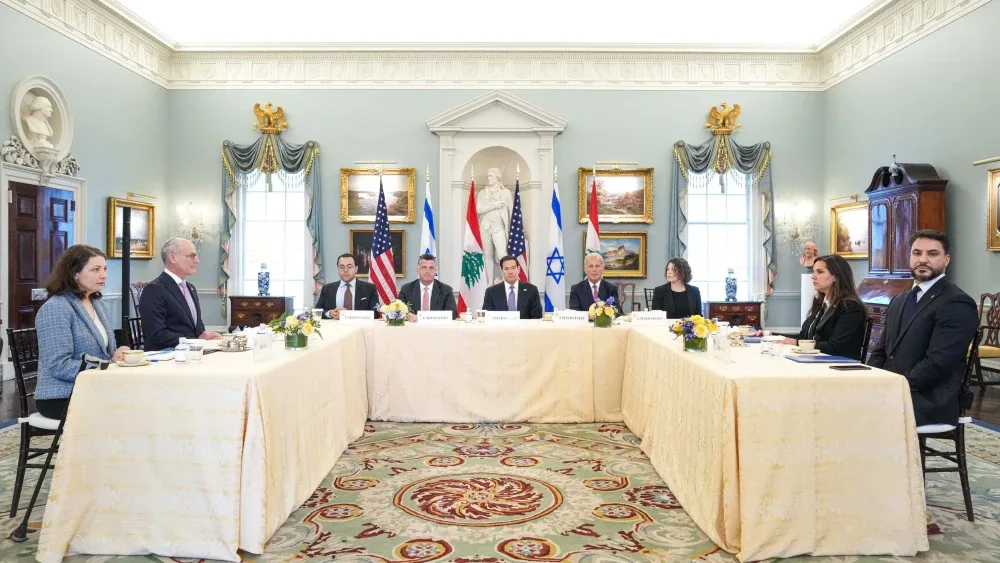
Israel and Lebanon reached a significant agreement to initiate the phased removal of Hezbollah militants from southern Lebanon, specifically south of the Litani River. The deal, secured after over eight hours of negotiations at the U.S. State Department, aims to replace Hezbollah’s presence in the area with the Lebanese Armed Forces, marking a critical step to improve regional security.
The agreement was finalized during the fourth round of direct talks between Jerusalem and Beirut, mediated by the United States. A key condition for maintaining the ceasefire between the parties is the complete halt of Hezbollah attacks and the withdrawal of all Hezbollah operatives from the South Litani sector. Officials emphasized that this withdrawal will open the door to a wider peace and security arrangement.

According to Israel’s ambassador to the United States, participants in the talks managed to shift the Lebanese perspective, clarifying that Israel is not their adversary but that Hezbollah, backed by Iran, undermines both Israeli security and Lebanese freedom. The diplomat highlighted the Lebanese commitment to removing Hezbollah’s influence as a historic and promising development.
Under the agreement, Hezbollah fighters, estimated to number around 2,000 in the south of the Litani, will be allowed safe passage northward. However, they are expected to relocate promptly; failure to do so will trigger consequences that both Israel and Lebanon understand clearly. This measure aims to avoid repeating the cycle of Israeli withdrawal followed by Hezbollah’s reassertion of control, which has destabilized the region for decades.
The initiative, termed the "pilot zones," will be closely supervised by the United States, with designated units of the Lebanese Armed Forces taking responsibility for securing these areas. The gradual expansion of Lebanese military control intends to solidify state authority and prevent Hezbollah’s return to southern Lebanon.
U.S. officials played a pivotal role in orchestrating the negotiations, with a State Department counselor serving as lead mediator. For Lebanon, a former ambassador to Washington now acting as a special presidential envoy led the delegation, while Israel’s ambassador to the U.S. steered the talks on behalf of Jerusalem.