

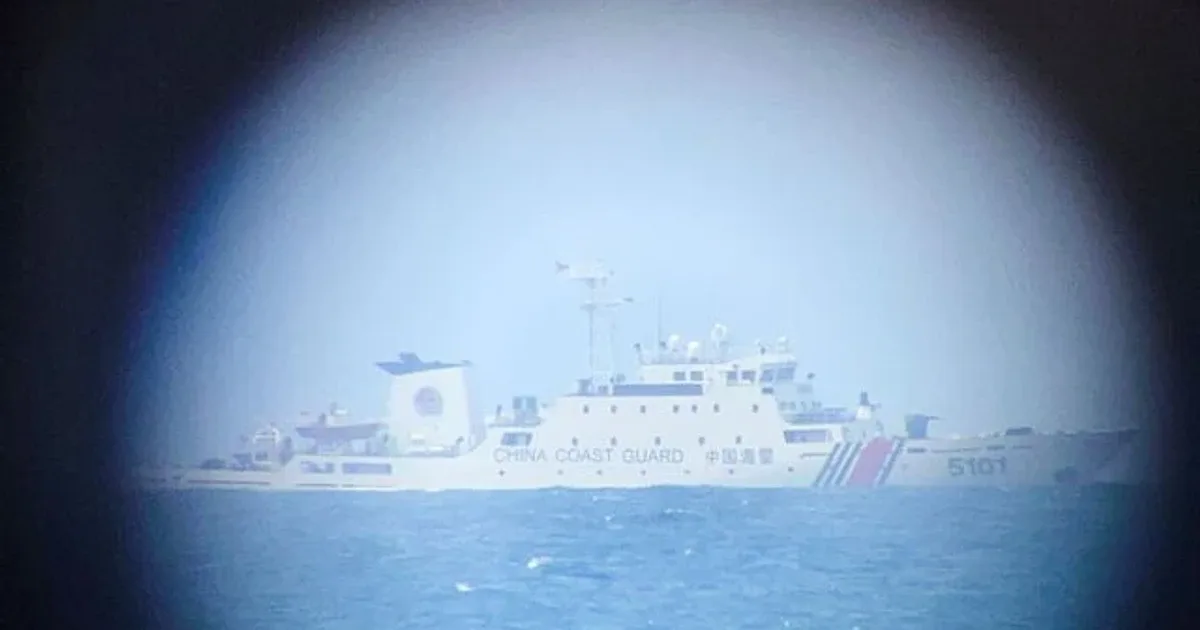
Fourteen governments spanning Asia, North America, and Europe have jointly rejected China’s extensive maritime claims in the South China Sea by reasserting the authority of a 2016 international tribunal ruling. This collective statement, issued on the ruling’s tenth anniversary, was spearheaded by Japan, the Philippines, and the United States, reinforcing the decision that declared China’s claims lacked legal foundation under international law.
The statement emphasized that the tribunal’s award, which addressed maritime entitlements between China and the Philippines, is final, legally binding, and definitive. It specifically upheld the exclusive economic zones and continental shelf rights of the Philippines while invalidating China’s broad assertions in the disputed waters. The multinational declaration involved Australia, Canada, Estonia, Germany, Italy, Latvia, Lithuania, New Zealand, Romania, Slovenia, the United Kingdom, alongside the lead nations.

Released simultaneously by the U.S. State Department and Global Affairs Canada, the statement reflects a coordinated ministerial-level effort rather than routine diplomatic communication, underscoring the seriousness of the message. The underlying legal framework is the arbitration constituted under Annex VII of the United Nations Convention on the Law of the Sea (UNCLOS), which ruled against China’s claims as unsupported by international law.
The European Union, reacting on the same day with its own statement, expressed deep concern over escalating tensions and hazardous incidents in the region that threaten maritime stability and freedom of navigation. This signaled that opposition to China’s claims has extended beyond the immediate U.S.-Japan-Philippines security framework to encompass broader international stakeholders worried about maritime order in the crucial waterway.
China swiftly responded by summoning Japan’s chief embassy minister in Beijing, protesting the joint statement and the endorsement from Japanese officials. The Chinese foreign ministry condemned the remarks as undermining regional stability and urged other countries to refrain from supporting actions that challenge its position.
The South China Sea remains one of the globe’s most contested maritime areas, where the Philippines has accused China of conducting dangerous maneuvers inside its exclusive economic zone. While the recent statement does not entail enforcement actions like patrols or sanctions, it significantly broadens the diplomatic pressure on Beijing and tests the potential for a wider coalition to uphold international law in the region.