

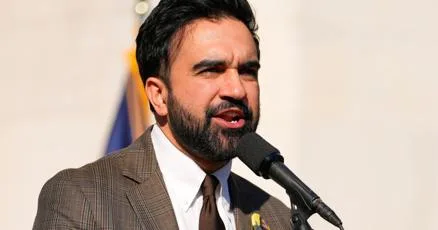
For the first time in decades, New York City’s mayor did not participate in the Israel Day parade, a flagship event celebrated annually on Fifth Avenue to mark the founding of Israel in 1948. This break from tradition underscores Mayor Zohran Mamdani’s public stance supporting Palestinian rights, diverging from a long history of political leaders attending the event to show solidarity with the city’s large Jewish community.
Mamdani had made his intentions clear well before the parade, highlighting his opposition to aspects of the Israeli government and releasing a video commemorating the Nakba, a term Palestinians use to describe the displacement of approximately 700,000 Palestinians during the 1948 Arab-Israeli conflict. The mayor emphasized that his absence from the parade reflected his commitment to these views while assuring that city police would ensure the event proceeded peacefully.

This decision sparked a backlash from Jewish community leaders and advocates who criticized the mayor’s absence and the Nakba video for neglecting the broader historical context, including the experiences of Jewish refugees expelled from Muslim-majority countries and the Holocaust’s influence on Israel’s creation. Rabbi Marc Schneier, a prominent Jewish advocate for interfaith understanding, characterized Mamdani’s actions as offensive to Jewish New Yorkers, urging him to stay away from future events.
Despite Mamdani’s choice, the city’s Police Commissioner, Jessica Tisch, who is Jewish, attended the parade and publicly affirmed her support. Her presence highlighted a division within city leadership regarding the event and Israel’s role within the broader community.
New York City has historically maintained strong political support for Israel, a stance reflecting its status as home to the largest Jewish population in the United States. However, political opinions toward Israel have shifted in recent years amid increased scrutiny of Israeli military actions and evolving public sentiment regarding the Israeli-Palestinian conflict.
Mamdani’s decision to abstain from the parade underscores these tensions, drawing attention to conflicting perspectives within one of America’s most diverse urban centers and signaling a potential redefinition of political alliances related to Middle Eastern issues in local government.