

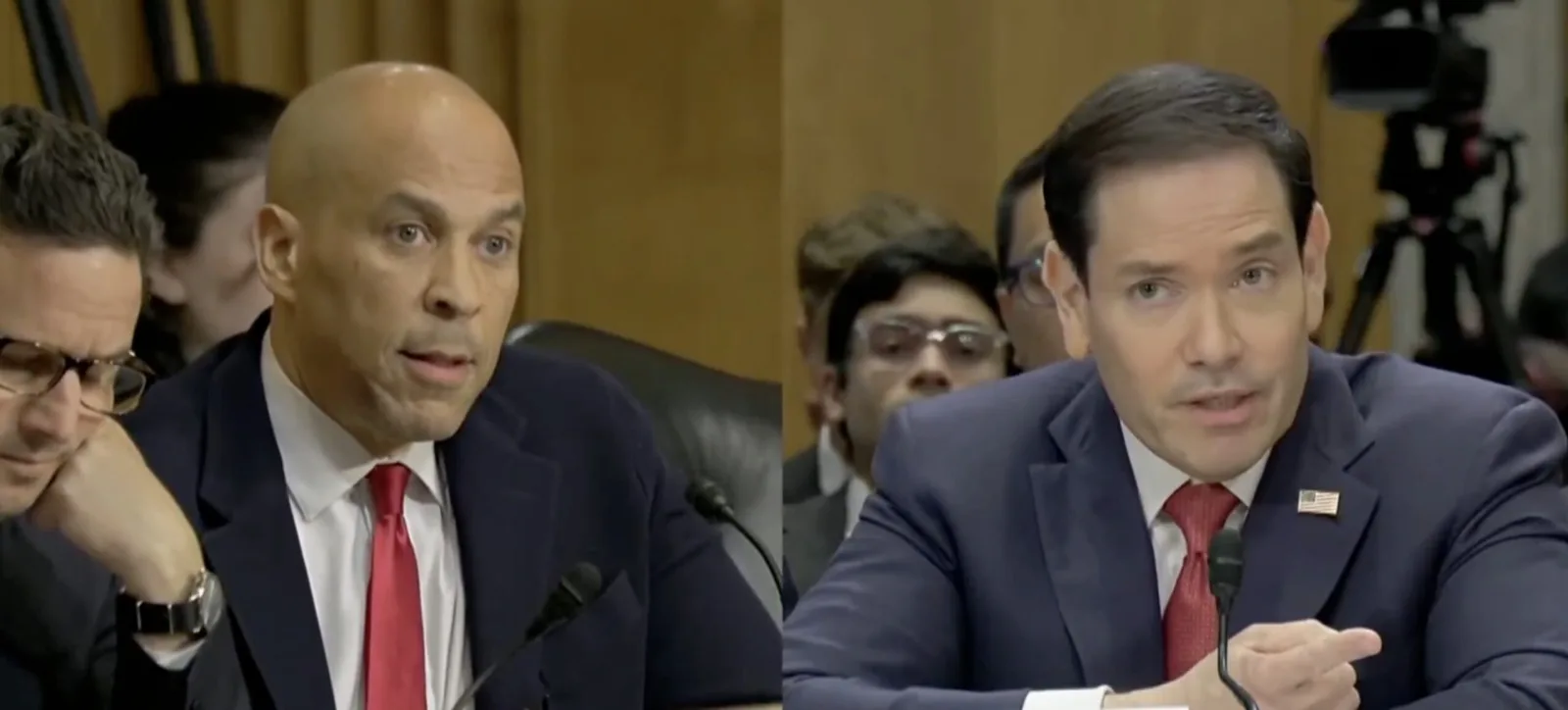
Marco Rubio pushed back firmly against Senator Cory Booker’s assertion that former President Donald Trump was pleading with Iran to return to the nuclear agreement. The disagreement unfolded during Rubio’s testimony before Congress on the State Department’s budget, where the two lawmakers sparred over the administration’s Iran policy and its geopolitical impact.
Booker criticized the conflict with Iran as "ill-conceived," arguing that the U.S. had weakened its negotiating position, leading to a stalemate that forced America into a desperate attempt to revive a deal it had previously abandoned. He framed the situation as Trump begging Iran for peace.

Rubio countered immediately, rejecting the notion of American desperation. He insisted no one was begging, pointing instead to Iran’s economic woes. According to Rubio, Tehran is suffering from severe financial losses daily due to sanctions and internal turmoil, describing an economy facing hyperinflation, currency collapse, and government payroll crises.
The senator detailed Iran’s deteriorated military capacities, including losses in missile launchers and defense infrastructure, while dismissing the idea that the country held stronger leverage now than before. He noted ongoing domestic protests prior to intensified sanctions, saying that the economic and political pressures on Iran have only deepened in recent months.
Rubio also noted that while Iran’s supreme leader and the Islamic Revolutionary Guard Corps remain resistant to external pressures, moderate elements within Iran's political class might pursue a deal if given the opportunity. This, he suggested, indicates a potential shift in Iranian willingness to negotiate under the right circumstances.
Booker remained skeptical, rebutting Rubio’s optimism by saying the conflict was far from resolved and highlighting public frustrations with rising costs and ongoing military tensions. Rubio responded by clarifying that, contrary to Booker’s claim, the war was effectively over.
The debate revealed starkly different views on U.S. strategy and foreign policy effectiveness regarding Iran, reflecting broader partisan divides over how to handle the country’s nuclear ambitions and regional influence. Rubio emphasized the continuing strain on Iran’s economy and military, challenging the narrative of Iranian strength often cited by critics of the Trump administration’s hardline stance.