

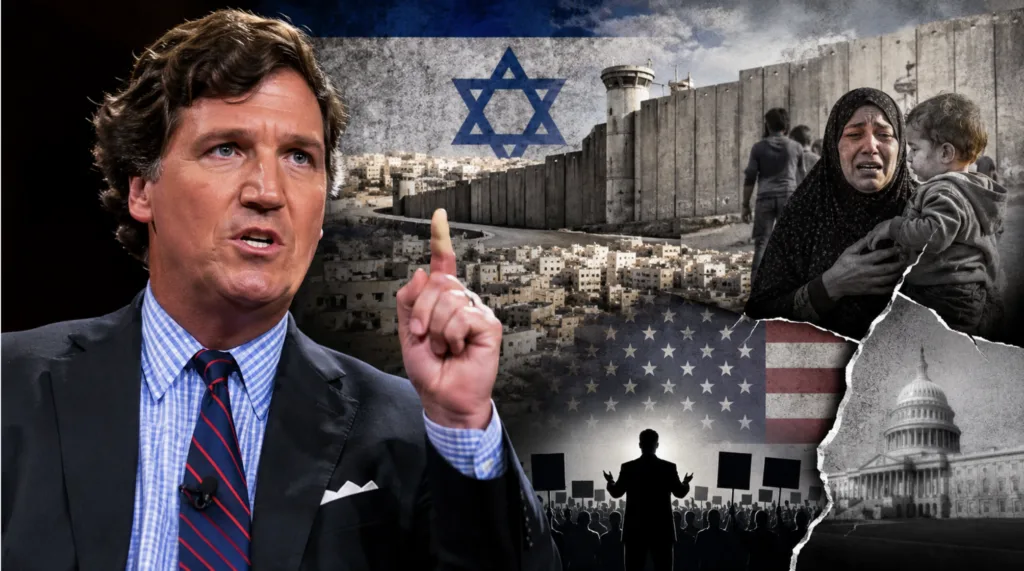
Tucker Carlson, a well-known conservative commentator, has publicly criticized Israel’s treatment of Palestinians, labeling it an “apartheid situation.” This marks a sharp departure from his previous alignment with the Republican establishment and former President Donald Trump, signaling a profound fracture in conservative politics regarding Middle East policy.
In an interview published by the Columbia Journalism Review, Carlson admitted he had largely avoided criticizing Israel over many years due to what he called an unwritten rule linking criticism of Israel to criticism of Jewish people generally. Despite this restraint, he said his views on the situation have remained consistent for two decades, rooted in firsthand experience from his multiple visits to Israel. He cited the 2025 war with Iran as the turning point that compelled him to speak out more candidly, describing the conflict as a regime-change effort driven by Israel rather than a straightforward geopolitical event.

Carlson revealed that he personally warned President Trump during several White House meetings about the risks of removing the Iranian regime, cautioning it would not lead to a democratic or pro-Western government. According to Carlson, Trump acknowledged the concerns but did not act on them. He also expressed sympathy for Trump, portraying the former president as a figure no longer in full control of his administration.
The commentator’s stance challenges what he views as a bipartisan consensus favoring Israel, which he connects to prolonged U.S. involvement in wars, financial interests, and American casualties. This ideological rift has motivated Carlson to explore the creation of a third political party in the United States, aiming to offer an alternative to the entrenched two-party system.
This development occurs amid ongoing debates within U.S. conservative circles, where unwavering support for Israel has traditionally been a key tenet. Carlson’s position represents one of the most prominent public criticisms of Israel from a mainstream conservative voice, reflecting broader tensions over U.S. foreign policy in the Middle East.