

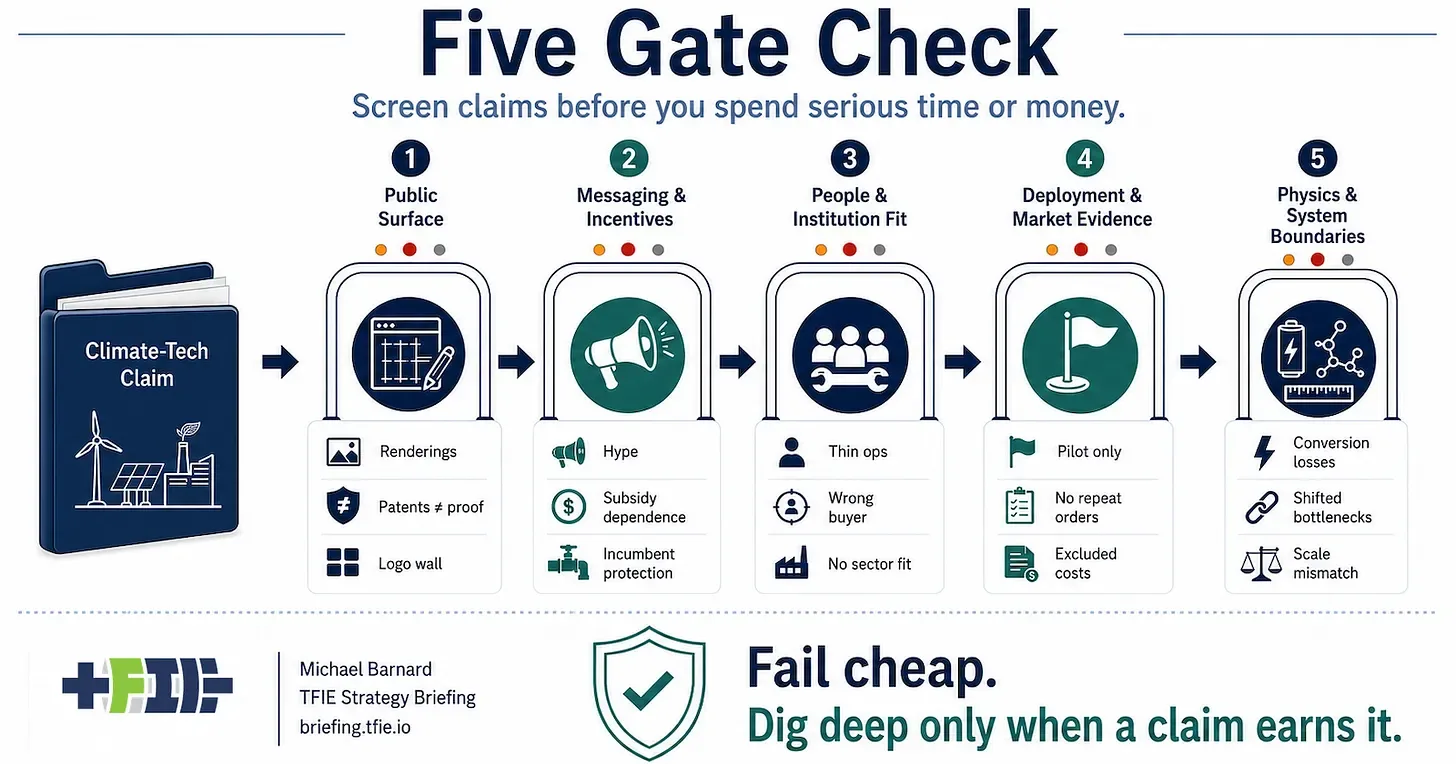
Many climate technology proposals come paired with both bold promises and requests for public funds or regulatory advantages. However, not every claim justifies the costly and time-consuming technical, financial, and legal analysis that often follows. Implementing a basic red-flag screening early on can help policymakers and investors decide whether a project warrants deeper scrutiny or should be paused before substantial resources are committed.
The first critical step is to examine the project's scale relevance—the denominator. A technology might function in a lab or a small pilot but still fall short of the practical scale necessary to impact decarbonization significantly. For instance, direct air capture systems can remove CO₂, but understanding how much CO₂ they can capture, at what expense, and with which infrastructure is crucial before deeming them viable. Likewise, hydrogen’s potential as an energy carrier depends heavily on whether it outperforms alternatives such as batteries or grid improvements in specific applications.

The second key check involves verifying the nature of the evidence supporting the claims. Actual market deployment and cost competitiveness differ vastly from announcements, letters of intent, or test pilots. While these indicate interest or experimentation, they do not guarantee that the technology performs reliably at scale, reduces emissions affordable, or has real customers ready to adopt the solution.
Another frequent pitfall lies in boundary setting—how the technology’s impact is framed. Some climate-tech claims omit key ancillary processes that add complexity and cost. A typical example involves hydrogen fuel-cell vehicles evaluated merely by tailpipe emissions, without accounting for the entire hydrogen supply chain, including production, compression, and distribution. Similarly, carbon capture projects might highlight captured CO₂ volumes but overlook challenges in transport, storage, monitoring, and liability management.
Adopting a low-cost initial filter helps avoid treating every new concept as equally serious and ensures resources focus on innovations that demonstrate technical feasibility, credible scale potential, and realistic paths to market. This approach serves as a practical safeguard that can reduce wasted investment and policy missteps by catching fundamental red flags early. In a sector where complexity and hype coexist, a modest upfront diligence effort offers significant benefits.