

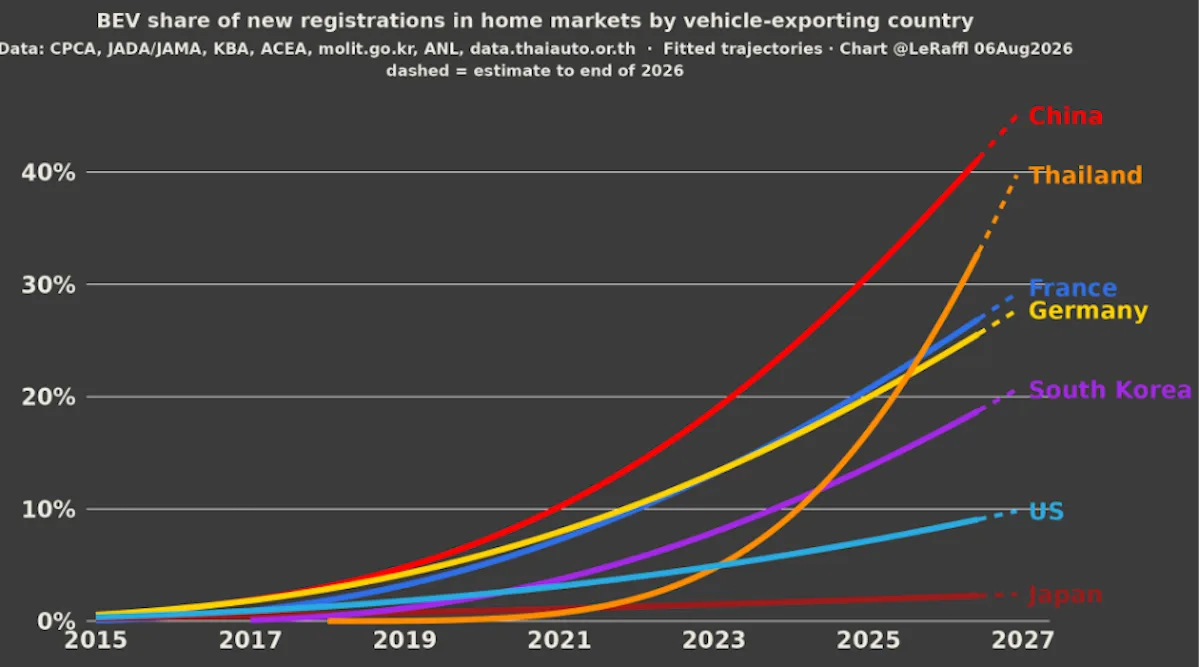
Europe’s battery-electric vehicle (BEV) market recorded its strongest growth to date in the first half of 2026, with BEVs accounting for just over one in five new car registrations. However, this impressive milestone still falls short of the scale China has already reached, where nearly half of new cars sold are fully electric.
Data reveal that Europe is improving steadily but remains a mid-tier player in global electrification efforts. While the European Union saw BEV registrations jump by more than 30% compared to the previous year, the overall shift toward battery-electric models is tempered by the continued dominance of hybrid vehicles, which comprise over one-third of new registrations across the bloc.

The fastest European markets include France, where BEVs captured nearly 30% of new car sales in June, and smaller countries like Norway, Denmark, and the Netherlands, which even surpassed China’s BEV market share for that month. Still, Germany — known as the birthplace of the automobile — reached a significant milestone in June with electric cars outselling every other fuel type, yet its overall BEV share remains below China’s rate.
This pattern, coupled with new analysis indicating that charging infrastructure across Europe now outpaces EV sales, signals that Europe’s main obstacle is not lack of consumer interest or supporting infrastructure. Instead, the bottleneck lies in the pace of industrial adaptation and policy transformation within the European automotive sector.
Globally, when comparing major vehicle-exporting countries by their domestic BEV sales, Europe places between Japan and the United States on the lower end, while China and Thailand lead the charge with higher market shares. China’s domestic BEV share stood at nearly 43% as of mid-2026, underscoring its rapid industrial transformation.
Meanwhile, the total number of passenger car registrations in Europe fell year-on-year, reflecting broader market shifts amid this transition. Industry officials have raised alarms about the competitive threat posed by China's accelerating electric vehicle manufacturing, emphasizing the urgency of bolstering Europe’s production capacity and policy frameworks to avoid falling behind.