

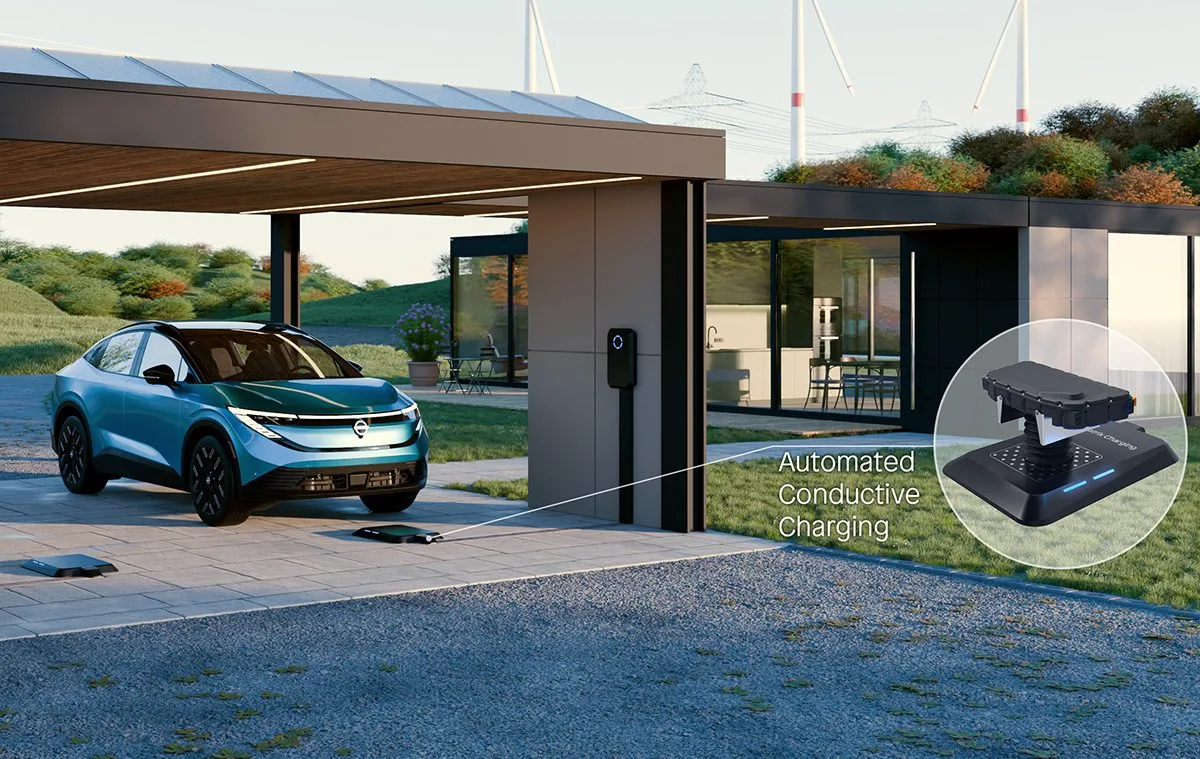
Nissan Technical Centre Europe (NTCE) and Austria-based Easelink have teamed up to develop an automated, hands-free electric vehicle (EV) charging system aimed at maximizing vehicle-to-grid (V2G) potential. This new technology allows EVs to connect to the grid automatically whenever parked, overcoming the common issue of drivers neglecting to plug in as their battery charge increases.
Data collected by Nissan from over 40 global V2G projects reveals a tendency among drivers to avoid plugging in once their battery reaches a sufficient charge level, reducing the availability of EVs as flexible energy resources during peak demand periods. By automating the connection process, the collaboration seeks to increase the time EVs stay connected to the grid, thereby enhancing commercial viability for utilities and grid operators.

Easelink’s solution, called the Matrix Charging system, integrates a connector into the vehicle’s underbody and pairs it with a charging pad installed in designated parking spaces. When an EV parks over this pad, a flexible bellows mechanism automatically lowers to establish a conductive charging connection, requiring no intervention from the driver.
This initiative aligns with the work of the Matrix Charging Interest Group, co-founded by Nissan, Easelink, Audi, and Voyah. The group focuses on harmonizing technical standards to ensure better interoperability of automated charging systems, complementing the ISO 15118-20 communication protocol that governs EV and charger interactions. Despite the standard, variations in implementation can hinder seamless connection across different brands.
The joint development reflects a shared commitment to integrating EVs smoothly into renewable energy grids, advancing both technology and industry standards to facilitate wide adoption of automated V2G charging solutions.