

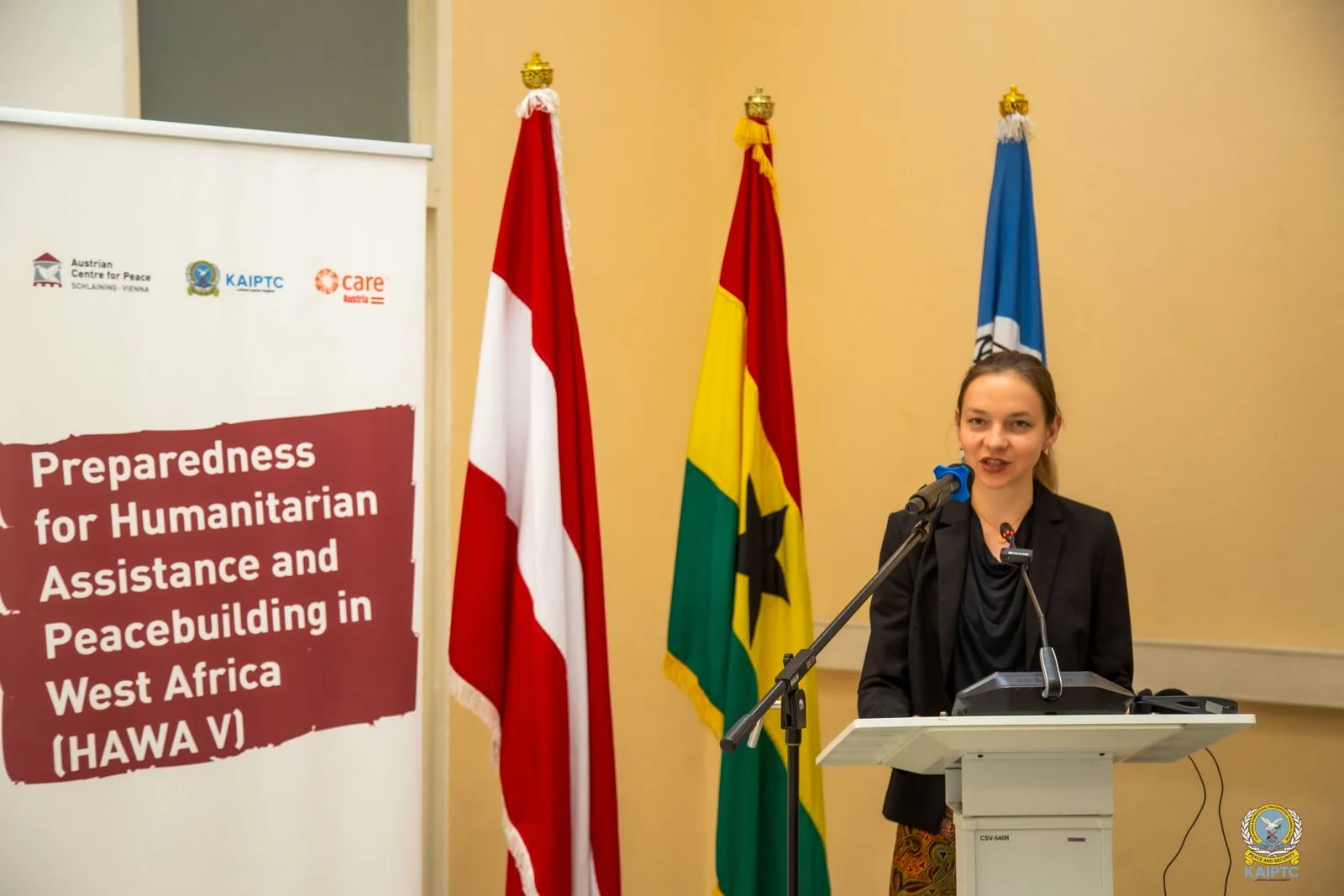
Extreme weather is no longer an anomaly but a persistent challenge, demanding urgent action to reshape humanitarian responses across West Africa and beyond. Sophia Stanger, Project Manager of the Preparedness for Humanitarian Assistance and Peacebuilding in West Africa (HAWA) programme, stressed this urgency during the recent HAWA Core Course at the Kofi Annan International Peacekeeping Training Centre (KAIPTC) in Accra.
Stanger outlined that the HAWA initiative, now entering its fifth phase, is more than a training effort. It serves as a long-term framework designed to fortify resilience, peacebuilding, and humanitarian preparedness throughout West Africa. The program is a collaborative effort involving KAIPTC, CARE Austria and CARE International Ghana, and the Austrian Centre for Peace (ACP), each bringing specific expertise to address the intertwined humanitarian, development, and peace challenges in the region.

KAIPTC leads on peace and security training, CARE prioritizes humanitarian and development programs with a focus on women and girls, and the Austrian Centre for Peace contributes critical skills in mediation, dialogue, research, and capacity building in conflict-affected areas. This blend strengthens the so-called humanitarian-development-peace (HDP) nexus essential for enduring stability.
Stanger emphasized that participants’ involvement in the Core Course is only the starting point of a broader engagement. Beyond structured training sessions, the program extends to specialised courses, Training of Trainers (ToTs), and practical field activities targeting border areas in Ghana, Togo, Côte d’Ivoire, and Burkina Faso. It also sustains an active alumni network to facilitate ongoing collaboration and knowledge sharing.
Highlighting the global dimension of climate disruptions, Stanger contrasted the heatwaves that recently afflicted Austria—with temperatures soaring beyond 40°C, causing deaths and infrastructure failures—with West Africa’s severe flooding and related emergencies. These examples illustrate the evolving and pervasive nature of climate-related risks threatening humanitarian stability.
In response, Stanger called for humanitarian systems to become climate-responsive, underlining the need for integrated regional strategies that combine peacebuilding with disaster preparedness. She underscored that such an approach would better equip communities to withstand and recover from the intensifying impact of climate emergencies.