

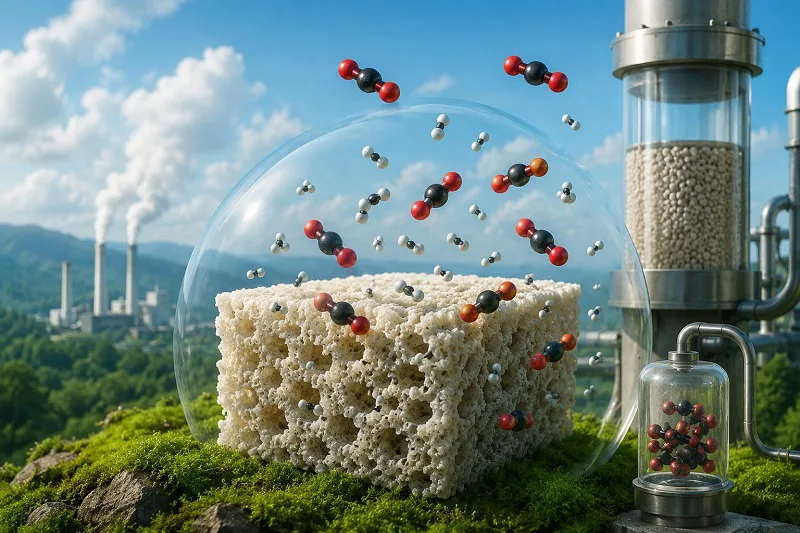
A team of scientists from Universitat Jaume I of Castelló in Spain has developed a novel absorbent material capable of extracting carbon dioxide (CO₂) directly from ambient air with improved efficiency. This innovation targets the challenge of low atmospheric CO₂ concentrations, which complicate direct air capture efforts, and offers a potential boost in reducing greenhouse gas levels.
The new material, a specialized class of absorbent salts, surpasses common carbon capture agents like amines, which often degrade, evaporate, or lose effectiveness at low CO₂ concentrations. The Spanish researchers demonstrated that their absorbents can selectively capture large amounts of carbon dioxide while leaving other atmospheric gases largely unaffected, increasing the efficiency of the separation process.

Tested successfully in laboratory environments, the absorbents performed better than existing commercial benchmarks when filtering CO₂ from both normal air and industrial gas mixtures. Their high selectivity and capture capacity at trace CO₂ levels mark a significant advantage over traditional methods.
Once captured, the carbon dioxide can be released in a controlled manner for underground storage or reused in manufacturing processes, aligning with broader climate mitigation goals. The technology could integrate into current carbon capture infrastructures without major redesigns, simplifying industrial adoption.
This development may also enhance the treatment of industrial emissions, as it can remove CO₂ from factory exhaust before it reaches the atmosphere. Additional applications include upgrading biogas fuels by eliminating excess carbon dioxide, improving their energy quality.
The research team, led by Marcileia Zanatta, has filed for a Spanish patent on this technology, signaling its potential commercial value. The advancement reflects ongoing scientific efforts to complement emission reductions with direct removal strategies, addressing climate change by tackling existing atmospheric CO₂.