

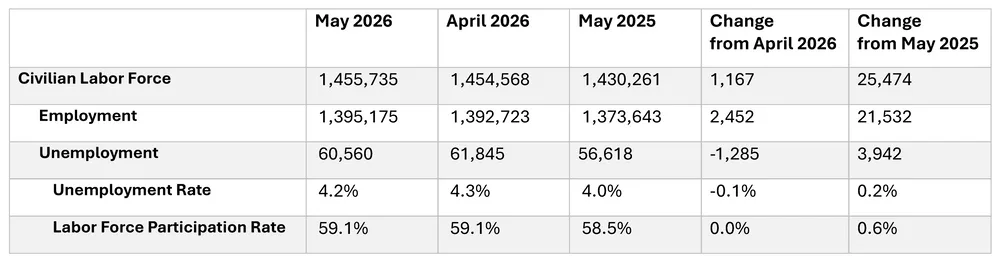
Arkansas achieved a historic milestone in its labor market as employment hit a record high in May, supported by a slight decrease in the unemployment rate to 4.2%. This decline marks a one-tenth percentage point drop from April’s rate, edging below the national rate, which held steady at 4.3%.
The state's labor force expanded as well, with an increase of over one thousand individuals entering the workforce. Employment rose by more than two thousand jobs for the month, reflecting sustained economic momentum. This marks the fourth consecutive month of a falling number of unemployed individuals actively seeking work in Arkansas.

On a year-over-year basis, Arkansas employed more than twenty-one thousand additional residents, even as the unemployment rate showed a slight rise compared to last May. The civilian labor force participation rate also grew over the past twelve months, indicating more Arkansans are either working or looking for work.
Nonfarm payroll employment in Arkansas soared to an unprecedented level of 1,351,700 jobs in May, adding nearly three thousand jobs since April. Eight of the state's major industry sectors experienced job growth during the month. Leisure and Hospitality led the gains with an increase of 2,100 jobs, setting a new record for the sector. Professional and Business Services followed, adding 200 jobs and also achieving a record high employment level.
Other sectors posted more modest seasonal advances, including Trade-Transportation-Utilities with an addition of 900 jobs and Construction with 500 new jobs. Over the year, these sectors exhibited robust growth, along with Private Education and Health Services, which added 1,400 positions.
Despite overall employment gains, the Government sector shrank by 1,800 jobs compared to May of the previous year, representing the largest annual decline among Arkansas industries.
The latest figures from the Arkansas Department of Commerce, in cooperation with the Bureau of Labor Statistics, reflect a steadily improving labor market marked by record employment and a lower unemployment rate that highlights the state’s economic resilience.