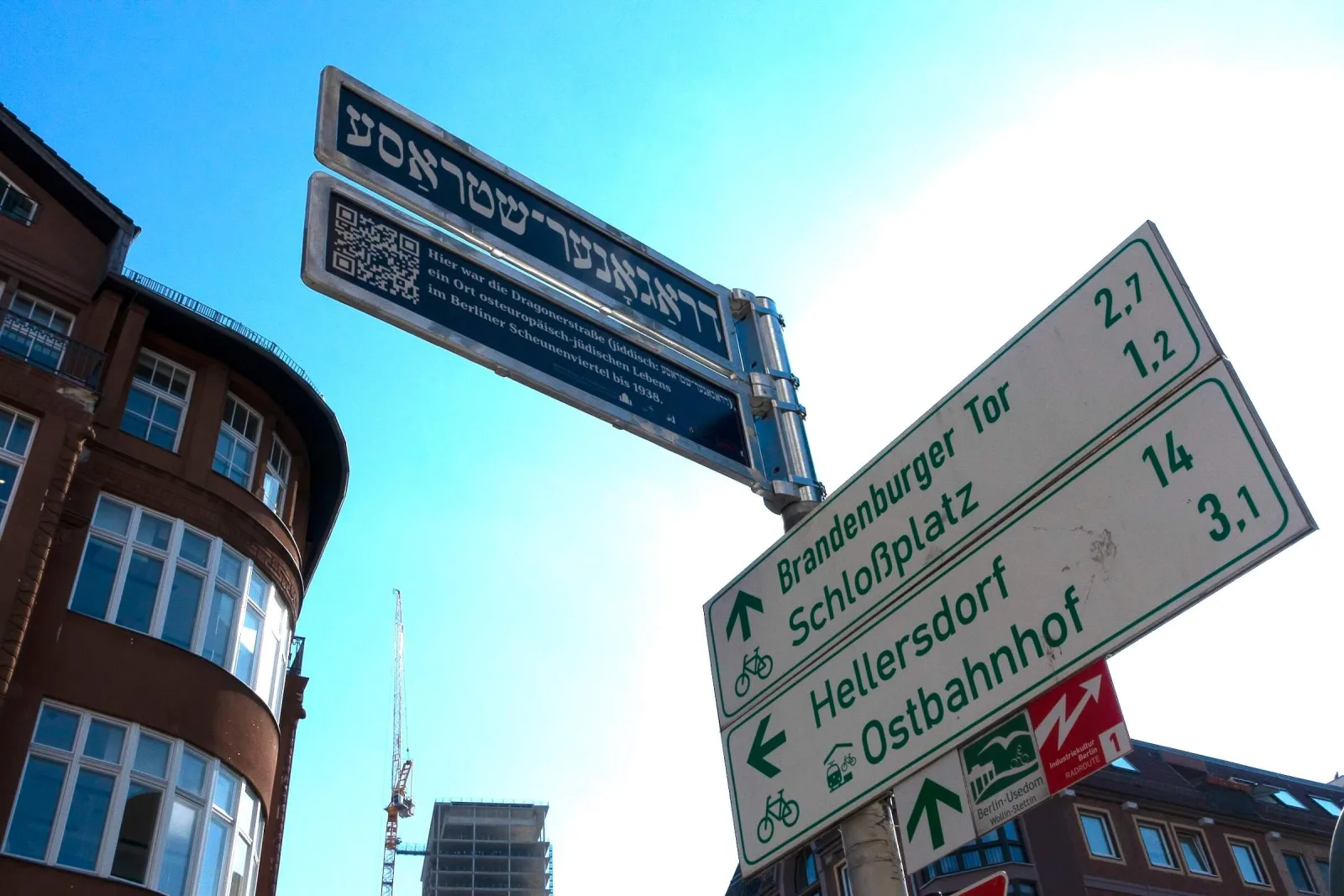
On March 11, officials unveiled a bilingual street marker on a corner of Berlin's old Jewish quarter, inscribed with a Yiddish spelling of the former street name above contextualizing plaques in German and English. The project emerged from an act of artistic defiance: in spring 2021, artist Sebestyén Fiumei illegally affixed a Yiddish street sign to a pole without permission, modeling it on the official German sign beside it. Though city authorities quickly removed it, the gesture moved Nathan Friedenberg, a Jewish district official, who partnered with historian Jess Earle to seek funding and approval for official Yiddish markers around the neighborhood.
The path to the official unveiling proved complicated. Regulations nearly prohibited the use of Yiddish altogether because it is not recognized as one of Germany's minority languages. Even design details—the white background, the words "sign" and "art"—faced bureaucratic objection. The final marker includes a QR code linking to a local history website titled "Without a trace?" and features Yiddish text alongside explanatory material in German and English.

The ceremony itself reflected an ongoing tension in how the project presents Yiddish. Though approximately 30 people attended, including at least four Yiddish professionals, the unveiling included no spoken Yiddish. Earle stated matter-of-factly that "Yiddish isn't the focus. It's only mentioned when completely necessary." Friedenberg acknowledged the omission and pledged to involve Yiddish speakers in future events.
The sign's emergence has revitalized a dormant campaign. Fiumei and his then-roommate Eliana Jacobs launched a Facebook initiative in 2021 calling for Yiddish to become Germany's eighth minority language. Though the page fell silent, the new official markers have prompted fresh momentum. Jacobs told supporters, "Let's relaunch the campaign!" and described it as "very realistic."
The comparison to other European languages underscores what Yiddish lacks. In Lusatia, a region 70 miles away, Lower Sorbian and Upper Sorbian place names appear on all village and street signs by legal mandate. Those languages enjoy protection under the European Charter for Regional or Minority Languages—a status that brings funding, research institutes, publishing houses, immersion programs, and salaried positions. Yiddish holds similar official status in eight European countries but not in Germany, despite its historical roots in German-speaking territories and its ongoing revival in Berlin's cultural scene. A vibrant community of Yiddish speakers now organizes music festivals, reading groups, poetry events, and cultural organizations like Shtetl Berlin and Yiddish.Berlin. Yet without official recognition, the language remains nearly invisible in public space.