

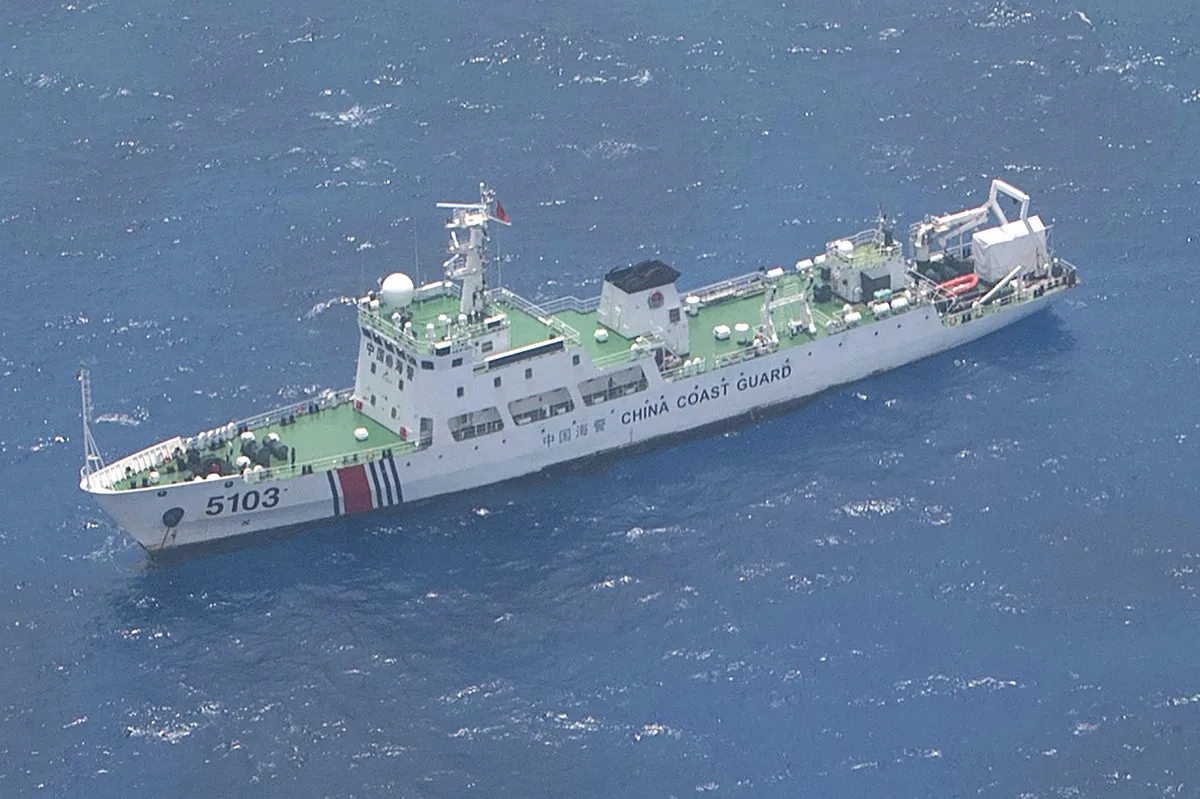
China launched a significant coast guard operation east of Taiwan aimed at countering negotiations between Japan and the Philippines over maritime boundary agreements. The talks seek to establish defined limits for exclusive economic zones (EEZs) and continental shelves in the Philippine Sea, a move Beijing condemned as an infringement on its territorial claims and maritime rights.
Central to China’s objections is its extensive territorial assertion, the so-called “nine-dash line”, which encompasses Taiwan and large portions of the South China Sea. This claim overlaps with those of Japan, the Philippines, and several neighboring countries, heightening regional tensions. Beijing views Taiwan as a self-governing province under its sovereignty, thus bolstering its justification to patrol these contested waters.

The Chinese coast guard, commanding the world’s largest fleet of its kind and outmatching many Asian naval forces, deployed the 5,000-ton cutter Daishan as the lead vessel for this mission. Taiwanese authorities also reported detecting a 3,800-ton cutter named Baita within their southeastern maritime zones. Taiwan’s coast guard is closely tracking both ships using its offshore patrol vessel Changbin, which weighs 600 tons.
In response to the Chinese presence, Taiwan’s Foreign Ministry publicly rejected Beijing's territorial claims and welcomed cooperation between Japan and the Philippines. Taiwan strongly condemned the Chinese operation as a deliberate attempt to undermine its sovereignty, accusing Beijing of political maneuvering and launching psychological operations.
This latest episode reflects the heightened competition over maritime boundaries in the East and South China Seas, areas critical for strategic security and resources. China consistently uses its coast guard vessels to enforce its claims, frequently confronting Japan and the Philippines in disputed waters.