

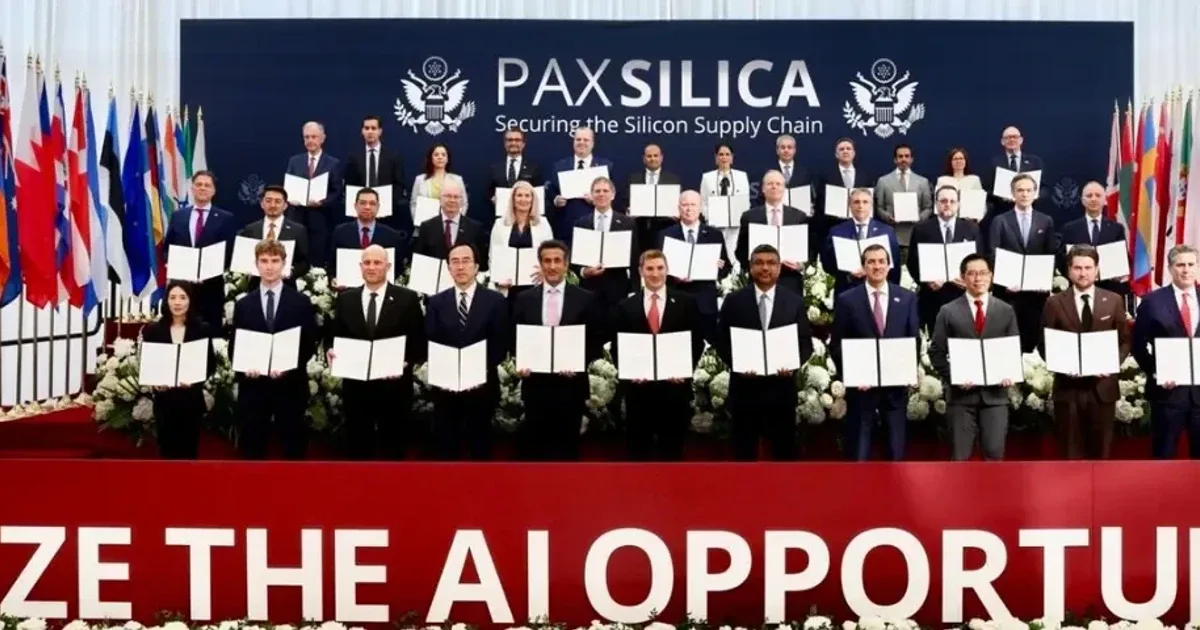
The European Union formally signed the Pax Silica Declaration, integrating one of the world’s largest economic blocs into a growing coalition dedicated to securing the global supply chains vital to artificial intelligence development. This pact, led by the United States, aims to safeguard the industrial foundation underlying AI technologies by coordinating resources such as critical minerals, semiconductors, energy inputs, advanced manufacturing, and logistics.
The coalition supporting Pax Silica now includes 24 signatories from across multiple continents, with recent additions like Argentina, Chile, Costa Rica, El Salvador, Germany, Greece, Kazakhstan, the Netherlands, and Panama. The US State Department—responsible for launching Pax Silica—describes the initiative as a flagship strategy to reduce vulnerabilities from dependency on single sources and coercive economic leverage in AI supply chains.

For Brussels, joining Pax Silica complements its ongoing strategy for digital autonomy and technological sovereignty. Earlier this month, the European Commission unveiled its European Technological Sovereignty Package, incorporating proposals such as Chips Act 2.0, a Cloud and AI Development Act, an EU Open Source Strategy, and a plan to digitalize energy systems. Officials pledged to collaborate with global partners under frameworks like Pax Silica to enhance supply chain security and accelerate AI innovation.
The move signals more than routine transatlantic alignment. The US State Department emphasizes the strategic nature of AI as tied to access and control over specialized compute capabilities and raw materials. By joining Pax Silica, the EU not only secures a seat at a united front aimed at maintaining resilient critical supply chains but also balances this cooperation with its independent regulatory measures to govern AI and digital infrastructure within Europe.