

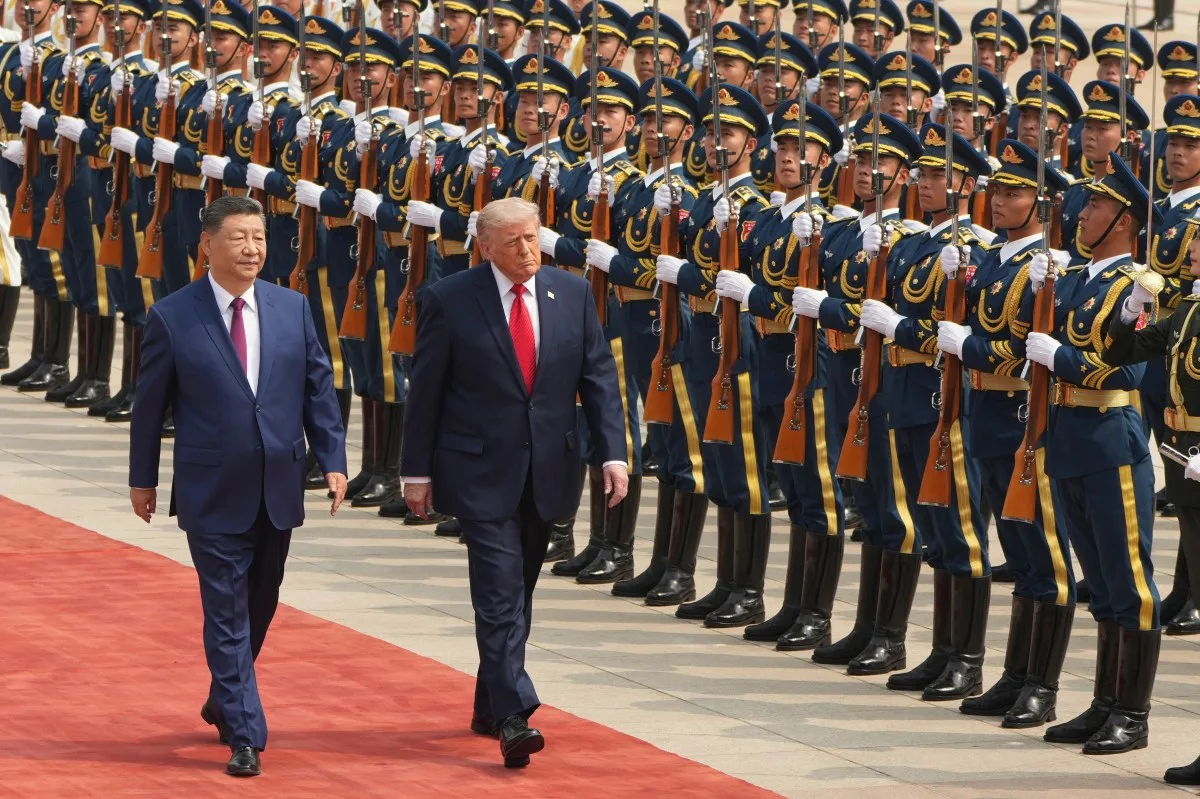
In a tightly watched summit at Beijing’s Great Hall of the People, Presidents Donald Trump and Xi Jinping launched critical trade discussions amid strained U.S.-China relations. Both leaders retreated behind closed doors after a public ceremony to address economic disputes and potential cooperation.
Trump arrived with a delegation of U.S. business leaders representing sectors such as aerospace, information technology, and agriculture. The delegation’s presence signaled the administration’s intent to secure reciprocal trade agreements and expand American access to the Chinese market. Trump framed the talks as an opportunity to "open up" China for U.S. business under mutual terms, reminiscent of early 2000s U.S. support for China’s World Trade Organization membership.

The evolving dynamics of the Chinese economy, however, present complications for foreign companies. China’s industrial policies have cultivated powerful domestic firms like Huawei and BYD, transforming them into fierce global competitors. Strategic initiatives, including control over rare earth metals, have heightened tensions in sectors critical to technology and manufacturing—a contest mirrored by U.S. protections of its semiconductor industry.
Despite growing rivalry, American companies maintain a significant presence in China’s industrial landscape. Tesla’s expansive factory in Shanghai narrows geographic and market gaps in Asia, even as it faces competition from local electric vehicle manufacturers. Apple continues to assemble its flagship iPhones in Chinese plants, which also serve as incubators for emerging domestic brands like Xiaomi.
Both nations hold stakes beyond commerce. With midterm elections approaching, Trump views new trade arrangements as potential boosts to the U.S. economy, especially in key regions. Meanwhile, stability in global affairs, including mitigating conflicts such as the Iran war, factors into the broader economic and political calculus, with implications for global energy prices.
President Xi emphasized the global spotlight on the summit, invoking the "Thucydides Trap"—a theory suggesting rising powers and established hegemons risk conflict. He underscored red lines in talks, warning against U.S. support for Taiwan, interference in China’s domestic politics, and criticism of its governance. Xi proposed that 2026 could mark a historic turning point in bilateral relations if mutual respect and cooperation prevail.