

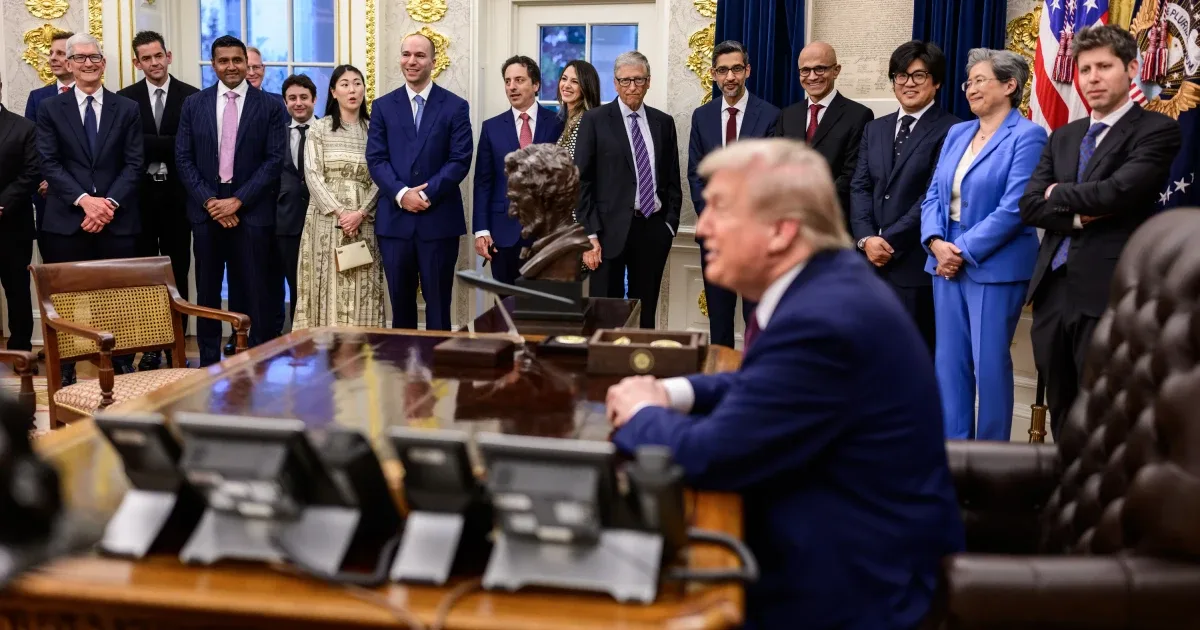
Former President Donald Trump is evaluating ways for the U.S. government to secure a financial stake in the burgeoning artificial intelligence sector. With AI companies like OpenAI and Anthropic moving toward initial public offerings, his administration is investigating how the public might directly benefit from the sector’s profits. This approach reflects a shift in the national conversation from solely regulating AI to determining how its financial rewards should be distributed.
Multiple strategies are under consideration. One involves appointing government representatives to the boards of AI companies, granting direct influence and potential financial dividends. Another explores targeted taxes on AI firms, aiming to recoup a portion of profits for public use. A third proposal suggests exchanging government funding or support for equity stakes—turning federal investment into a form of sovereign ownership akin to national champions in other industries.

This debate intensifies as AI firms prepare to tap public markets. Anthropic recently filed a draft registration statement confidentially with the U.S. Securities and Exchange Commission, followed by OpenAI, whose valuation estimates reach near or above $1 trillion. These market moves highlight the urgency for policy solutions that address who should share in the wealth generated by AI technologies.
The discussion extends beyond government equity to broader profit-sharing models. These proposals raise complex questions about eligibility, the mechanics of dividend distribution, and whether returns should come from stock ownership, direct dividends, or separate public funds. Vermont Senator Bernie Sanders has advanced this debate, proposing the American AI Sovereign Wealth Fund Act, which would levy a one-time 50% tax on AI companies’ stock. The act envisions transforming AI-generated wealth into recurring income for American citizens, potentially providing annual payments exceeding $1,000.
This policy conversation builds on groundwork laid by the Biden administration’s AI strategy outlined in the “Winning the AI Race: America’s AI Action Plan,” which recognized the importance of ensuring public benefit from AI innovation. Notably, OpenAI’s CEO discussed the idea of donating equity to seed a public fund with the Trump administration in 2025, signaling bipartisan awareness of the stakes involved.
As AI technologies rapidly evolve and dominate capital markets, determining the government’s role in sharing their financial success will shape the industry’s future and its integration into the broader economy.